
How Kerry GAA test, monitor, and manage injury risk

Most teams collect more data than they use. The question that matters isn’t what’s being measured, but what changes as a result.
In a RYPT Live Conversation, Jason McGahan, High Performance Manager with RYPT partner Kerry GAA, went through how Kerry have built their testing and monitoring practices from academy to senior. He covered what they measure and when, how the squad is profiled from academy through to senior, how they arrive at an injury risk picture for an individual player, and where that picture stops being useful on its own.

 With Conor Tierney (VALD) and Cormac O’Beirne (RYPT) · 16 min read
Everything in one place
The problem Kerry were solving for wasn’t a shortage of information. It was that the information sat in separate systems, which meant that relating one thing to another was a manual job, and the data couldn’t be overlaid in a way that gave meaningful insight.
Think about your own team and the data you collect. If you have GPS sitting in one system, volume load in another, growth and maturation in another, and you can’t easily see these side-by-side, it’s very hard to create a concrete understanding of an athlete or a team with all these disparate systems.
Jason describes what they were looking for from RYPT in those terms:
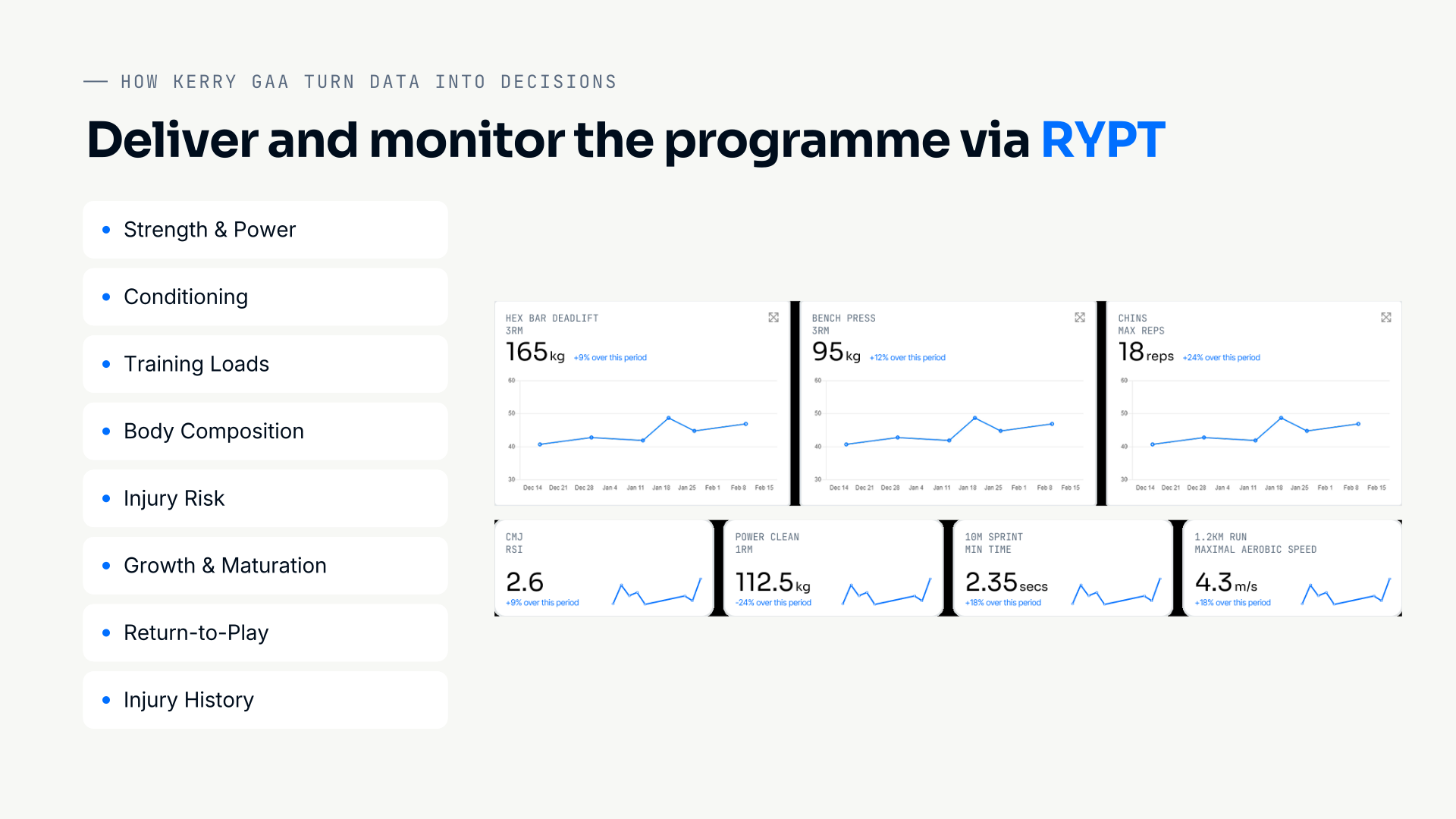
“What we wanted out of RYPT was a one-stop shop that integrated GPS into the system, and also looking at how we get the likes of VALD integrated with all our tests. So we’re not having all these different platforms from nutrition to athlete monitoring to GPS to VALD, so that everything comes directly into one place.”
One of the purposes of consolidating the data is access. Several groups of people need to see the same picture, and they’re not all in the room at the same time.
“What we’re looking to implement and monitor is assessing athlete performance, providing feedback and guidance so that all our performance staff can log in and see everything there in one place, reporting on development and physical fitness. So our underage coaches can go and see the programme, they can also see where they are in their development and the progress they’re making.”
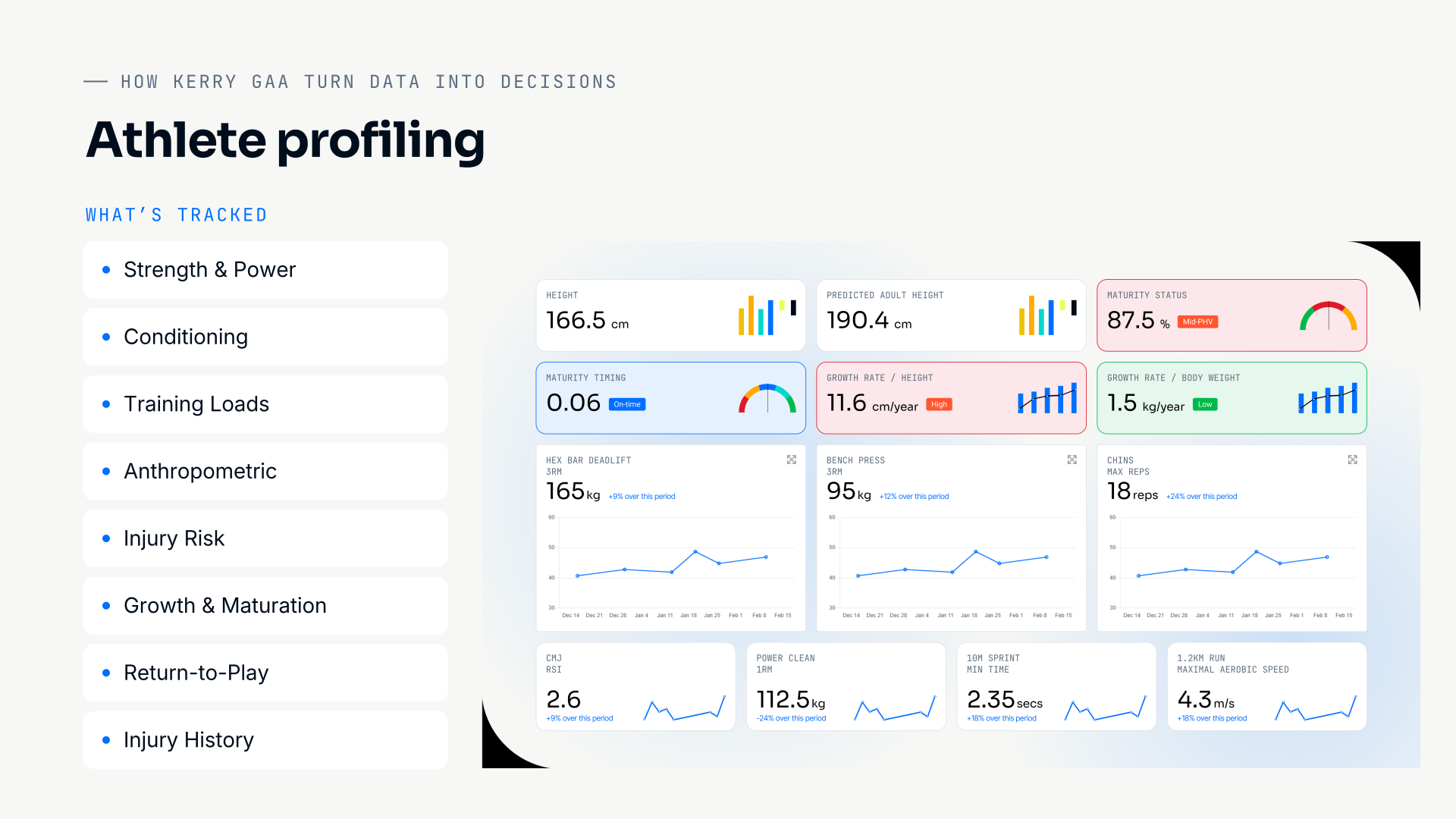
The scope is wide, covering strength and power, conditioning, training loads, body composition and DEXA scans, injury risk, growth and maturation, and return to play. Injury history and injured players are recorded in the same place.
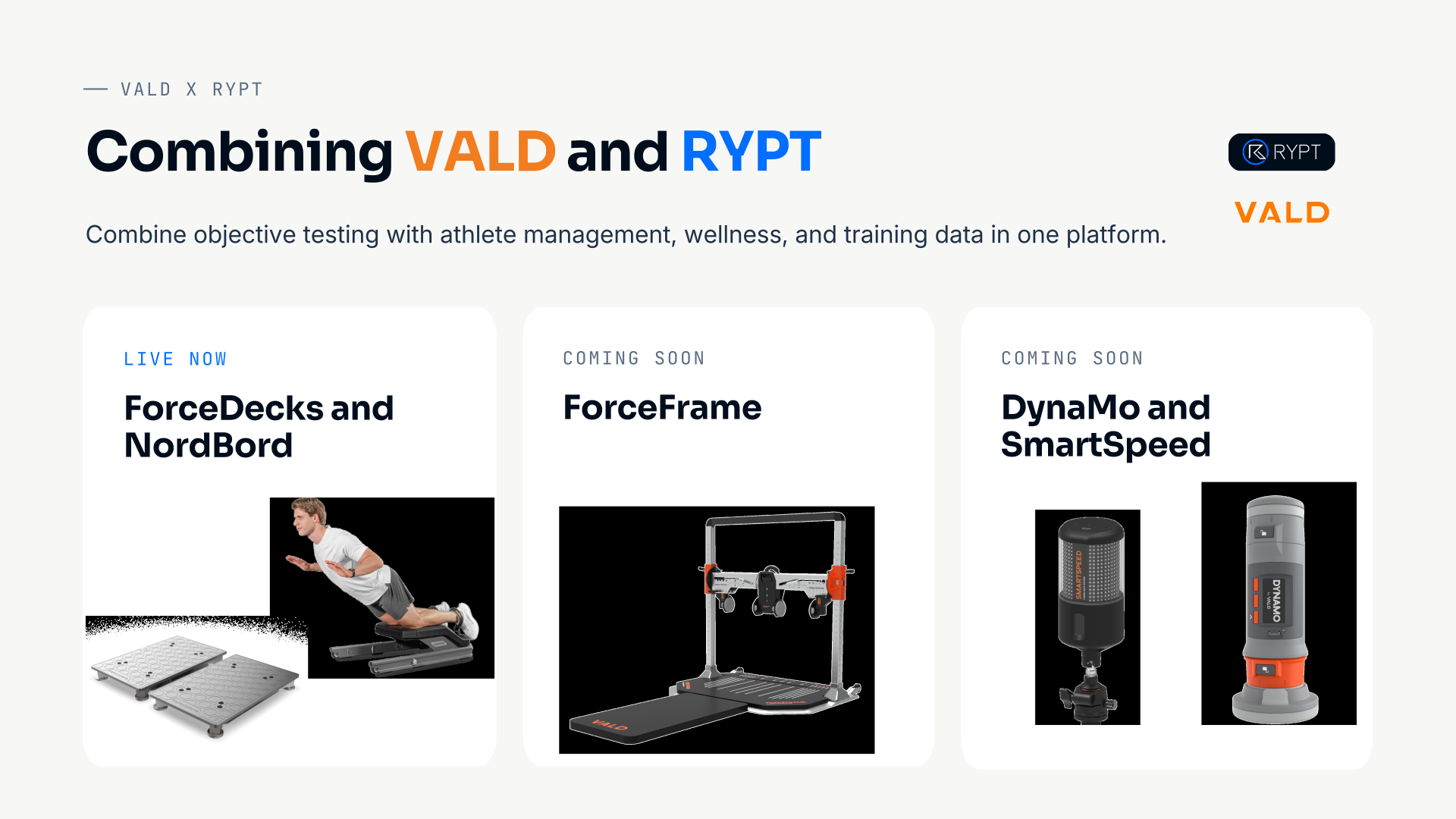
On the VALD side, Conor Tierney set out what is currently connected and what is coming:
“Combining the two, we currently have ForceDecks and NordBord within the RYPT app. Coming soon, we’re going to add ForceFrame, DynaMo, and SmartSpeed.”
The pathway from under 14 to senior
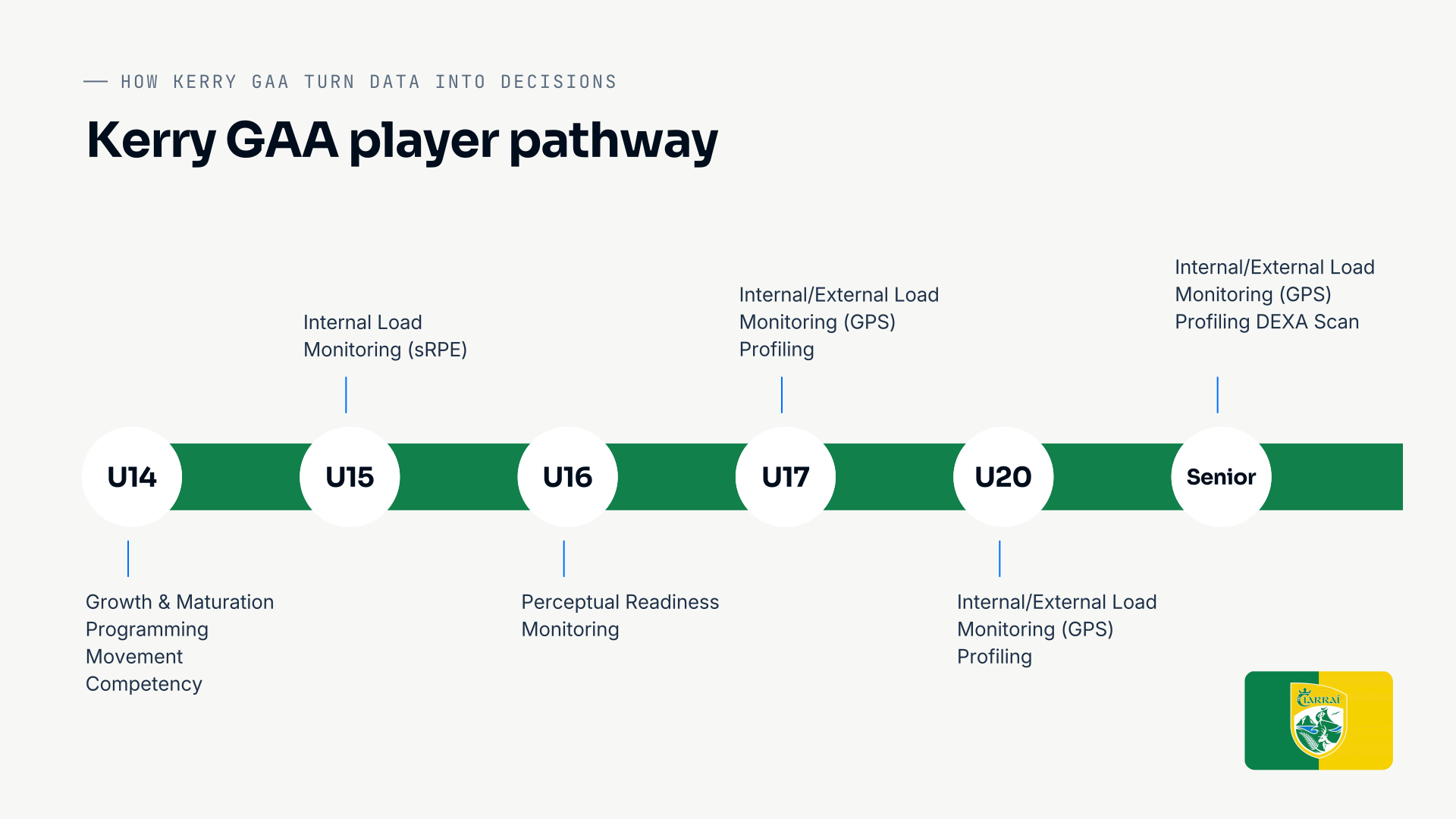
The relationship between data and player needs to be built over time so as not to overwhelm, so Kerry don’t switch everything on at once. A player entering the system at under 14 isn’t monitored the way a senior player is, and what gets added at each stage has a reason behind it.
At that first stage the work is physical markers around growth and maturation, recorded when the player enters the system, along with programme planning and movement competency. That record carries forward into the under 15s, where the focus shifts to teaching the player what the monitoring is for before asking much of them.
“We start educating the players around RPE and trying to explain to them about what load is, and simply monitoring and taking a look at that.”
At under 16 the wellness markers and perceptual readiness monitoring come in, and the context Jason gives for that is worth noting, because it’s not only county training the player is doing.
“Seeing how they are coping with the stress of not just development squad teams but also club and school.”
Profiling proper begins at minor, and that is also the point at which internal and external load monitoring and injury risk start being tracked. Those carry through the under 20s and into senior, where DEXA scanning and body composition are added.
Growth and maturation
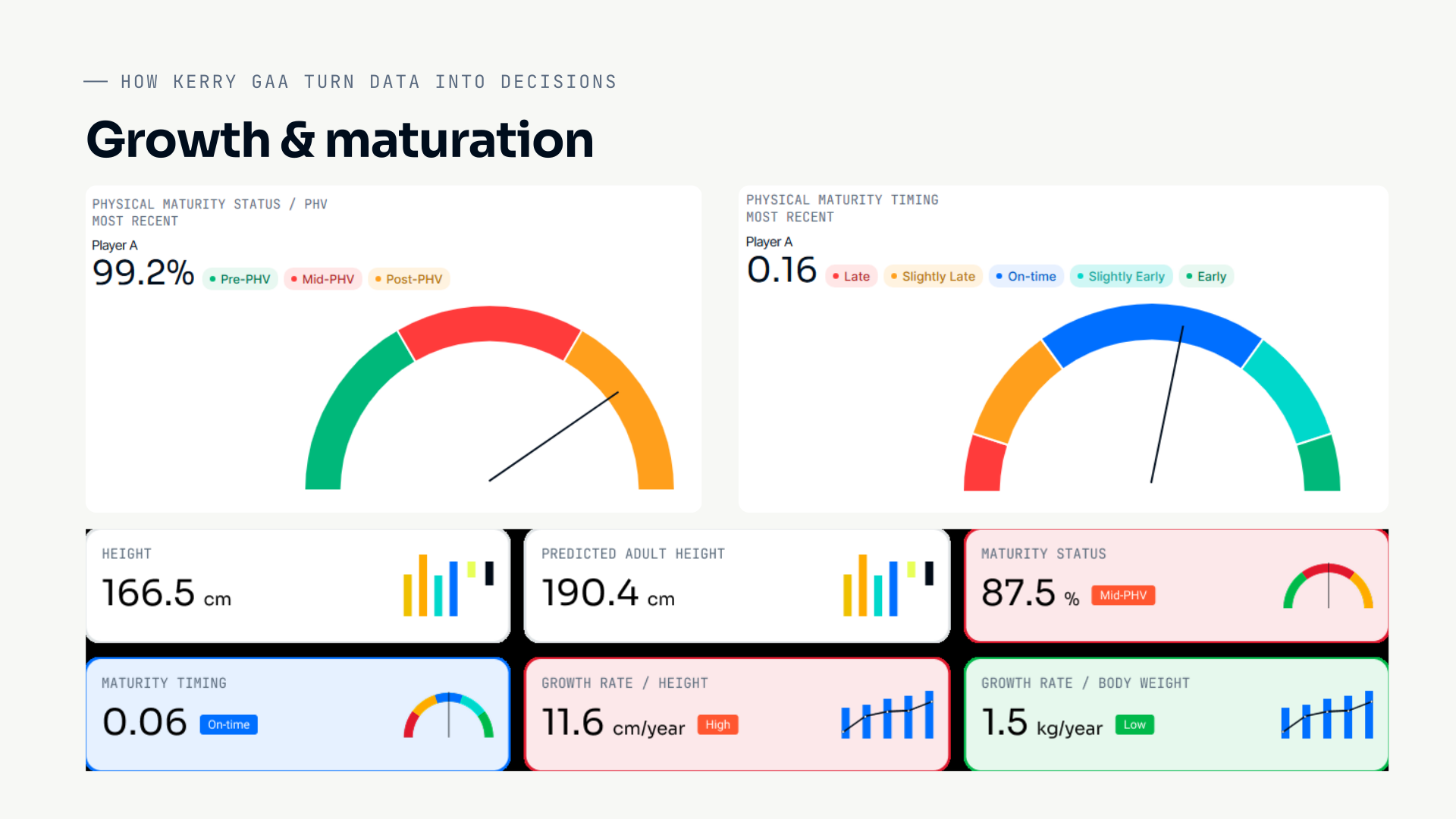
Kerry have been monitoring growth and maturation for the past four to five years, work that sits with Dr Fionn Fitzgerald, who began it as part of his PhD. The reporting from it goes to managers and coaches as part of what they receive on a squad.
The reason it matters for testing is that a physical test on a 14 or 15 year old is measuring maturity as much as it is measuring training.
“If the young lad is mature for his age, well then he’s going to be bigger and stronger than the late maturer. So he’s going to out test the late maturer. So sometimes this could be rewarding the more mature player at 14 or 15, if you’re starting to go into these more physical tests. Obviously he’s going to be stronger, he’s obviously going to jump higher, he’s obviously going to be faster.”
That leads to a position on when physical testing is worth doing at all.
Kerry retest growth and maturation around three times in a year, twice in the first part of the season and again when players come back into the gym in October, November, and December.
For clubs, Jason’s view is that the value depends partly on squad size, because grouping players by maturity status, or bio-banding, needs enough players to group.
“Some of the bigger clubs might have 50, 60 athletes or players in one age group, so you could have at least three different groups in that club at 14 or 15. Whereas you could have a smaller club that might only have 20 in the group of that age bracket, and it’s hard to distinguish because they’re running small numbers.”
Where grouping isn’t practical, the monitoring still has a use, which is knowing when an individual player is going through a growth phase and adjusting around it rather than pushing through it.
“What can be done is you can monitor it, and actually then know when that young lad is going through that cycle, that you can ease off the load or the intensity of his training and monitor it as he comes through that phase.”
He’s also direct about what that period looks like from the player’s side, and about the fact that performance dipping during it is expected rather than a problem to be fixed.
“Some of the athletes get a wee bit clumsier in this period. They might get pain here and there, and their performance might be impacted. But to allow them to navigate it and say ‘it’s okay’, and they’ll come out the other side of it, and kind of watch them, not be too hard on their actual training load.”
Deciding what to test
The part of the session with the widest application was Jason’s account of how Kerry reduced what they test, and why. He’s clear that the starting point was the opposite.
“When I first came in and we started, we had a list of tests, it took us a full day to do a fitness test, and it just wasn’t able to be done. Players were getting sick of it, coaches and managers were getting sick of it.”
The practical constraint is that a testing day costs a training session, which makes it something that has to be justified to the people running the team.
“It’s hard to get the buy-in from coaches and managers when you tell them you’re going to do a full day testing and you’ve got a list of 13, 14 tests. It’s not practical.”
The second constraint is capacity to actually use what is collected, which is a different problem from capacity to collect it.
“We were trying to gather up a groin squeeze, a sit and reach, a knee to wall, a hamstring test, CMJ, and more besides. We were gathering data for the sake of gathering data and we didn’t even have enough time to actually look at the data to make rational decisions off it.”
What they settled on was fewer tests done more reliably and more often, rather than more tests done poorly across a longer window.
“We said right, why don’t we do one or two tests and concentrate on them and make them more reliable, to get done every week, as opposed to trying to get six or seven tests done and getting them done to mediocrity across a month.”
The test he applies to any measure is whether it changes practice.
Part of what shaped Kerry’s approach came from outside the GAA. Jason describes meeting Dr Ben Rosenblatt, formerly head of performance with the English FA, who was working against similar constraints with players arriving from clubs.
“They wanted to produce a measuring profile that can be easily accessed and easily done, and also allow them to train after it.”
That last condition is the one that makes a profile usable in a season rather than only in pre-season. Kerry also consulted Dr Gareth Sandford on aerobic testing, Dr Tim Gabbett on monitoring, and Dr Damian Harper on deceleration and turning.
Testing at club level
Asked what a club should do, Jason’s answer starts from the game rather than from the equipment available.
“Keep it very simple. Look at the game. Look at the needs analysis of the game. Look at what are the key indicators of the game. So I’d look at possibly four, five or six tests max, and you’ve got your strength, you’ve got your power, speed, and aerobic. And you might have one test that you might use for injury prevention, like a hamstring test, or you might look at a groin squeeze.”
On equipment, he’s explicit that the absence of it isn’t a reason to skip testing.
“At a club level, even a jump mat, or even just having them jump. If you’re working with 14 and 15 and 16 year olds and you don’t have it, just have them jump up against a wall with a bit of chalk in their hands and jump up and hit the wall. Keep it simple. Basically all you’re trying to say is, what you’re doing programming wise, is it doing what it’s meant to be doing.”
What Kerry measure
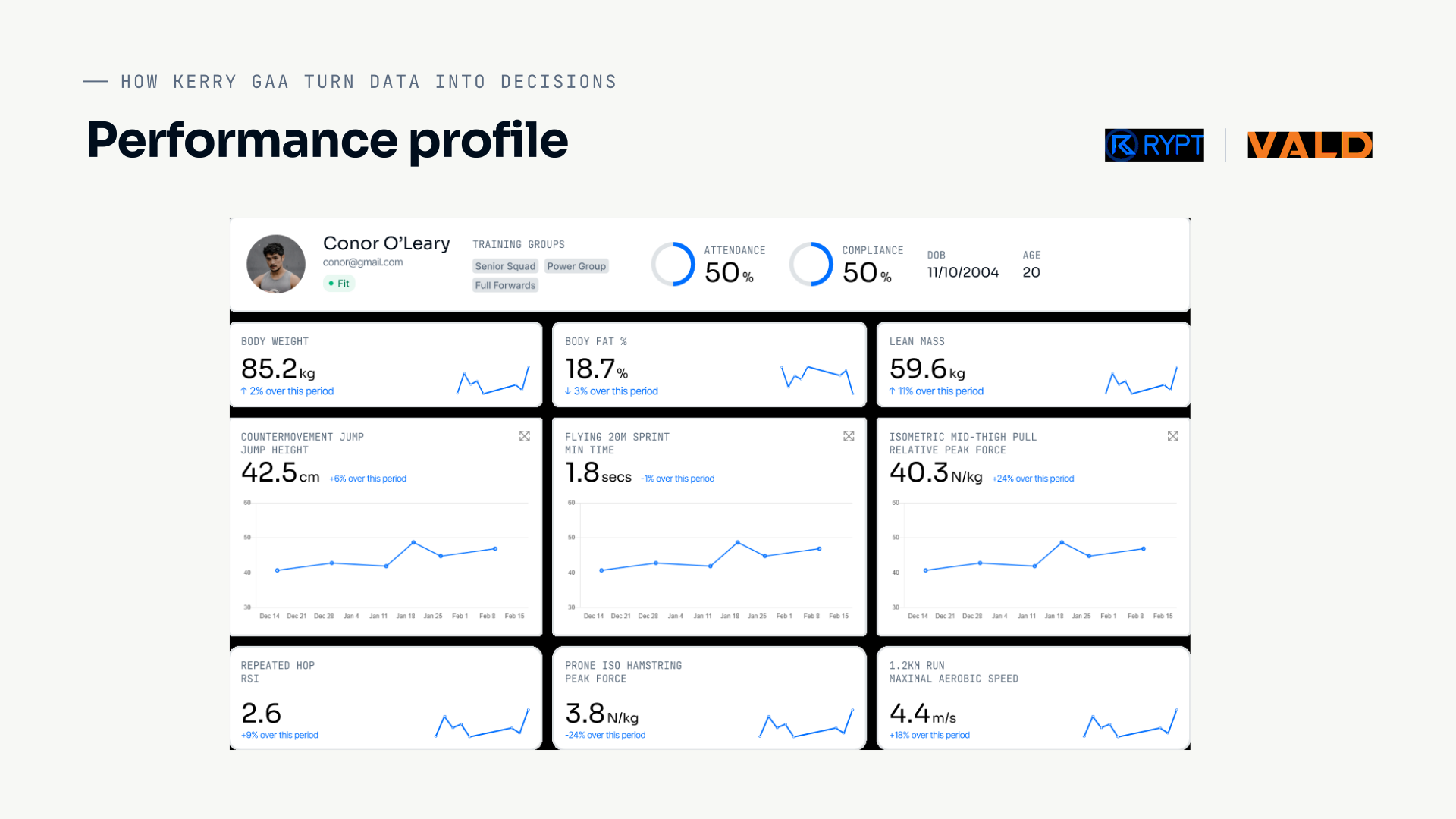
The profile Kerry settled on is short, and each item in it covers a different quality rather than a different version of the same one.
“The performance profile, things that we look at is our countermovement jump. We’ve got our flying 20 metre as well. We’ve got our ISO measures. We use the 1.2 kilometre aerobic test. We look at the prone ISO hamstring peak force and then the repeated hop RSI.”
Alongside that sit the gym measures, recorded continuously rather than on testing days, covering the hex bar deadlift, squat, power clean, and chin-ups.
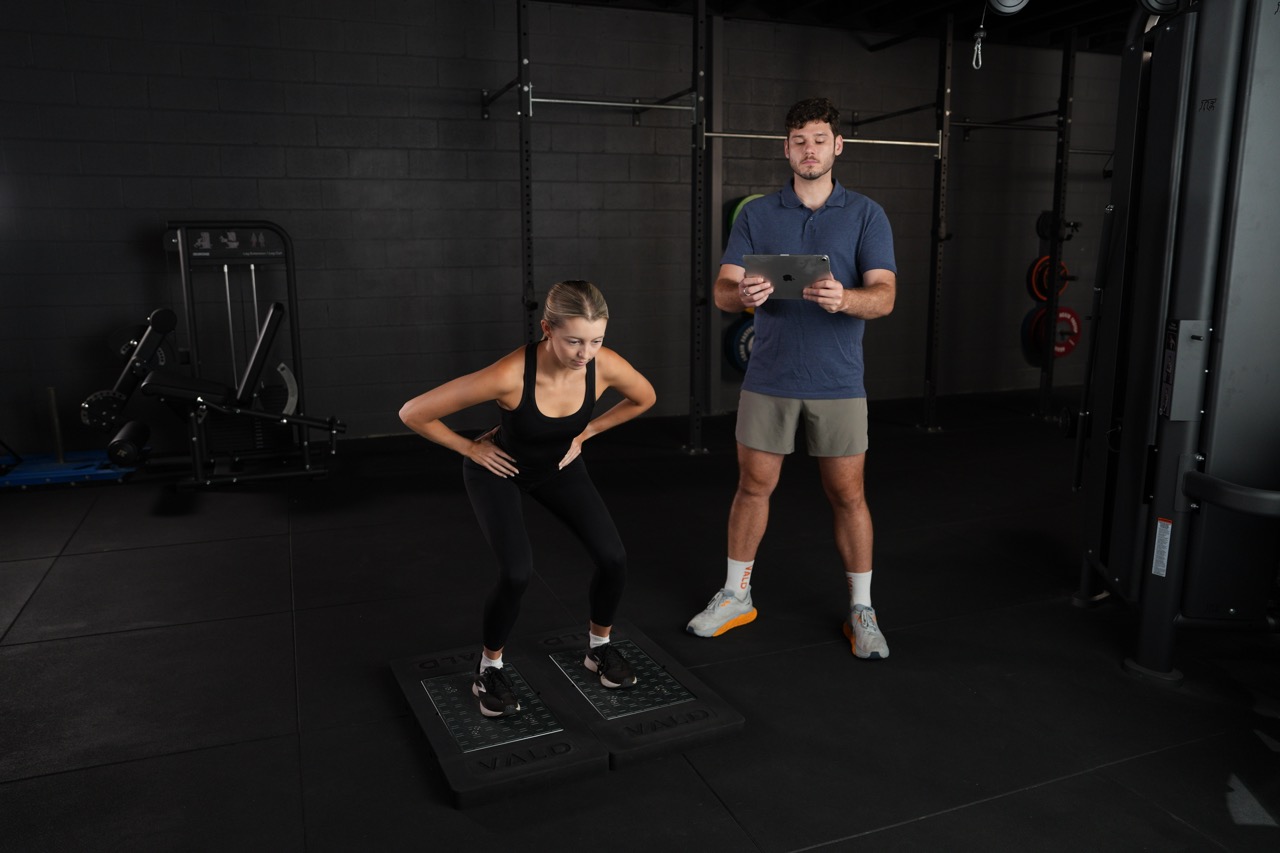
The testing itself runs on VALD equipment, with the mid-thigh pull measuring concentric vertical force into the ground, the prone ISO hamstring on the NordBord, countermovement and repeated jumps on the ForceDecks, and a ten metre acceleration to finish.
Getting the full squad profiled at one time isn’t realistic, which is a scheduling reality rather than a design choice.
“It can be tough, and Kerry is tougher, they tend to play a lot of football in Kerry. So you might have a group in November, a group starting in December, or you might have an odd group in January. So at no one point are you going to get the full squad in for a profile. So they may be profiled at different times.”
A second profiling window comes around the end of the National League in early April. Between those windows, jumps, hamstring strength, and speed are monitored on an ongoing basis rather than waiting for a testing day.
Static risk
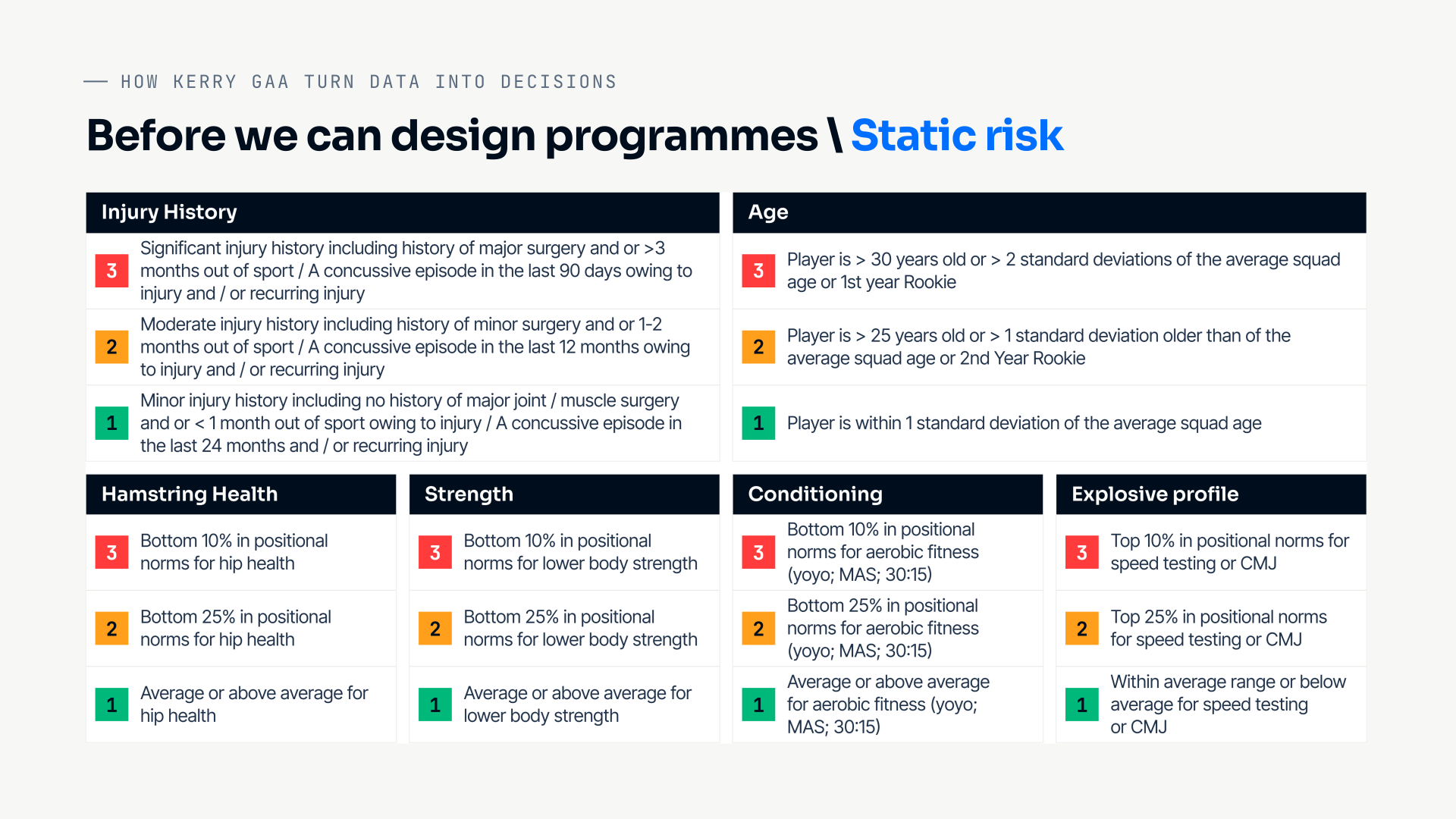
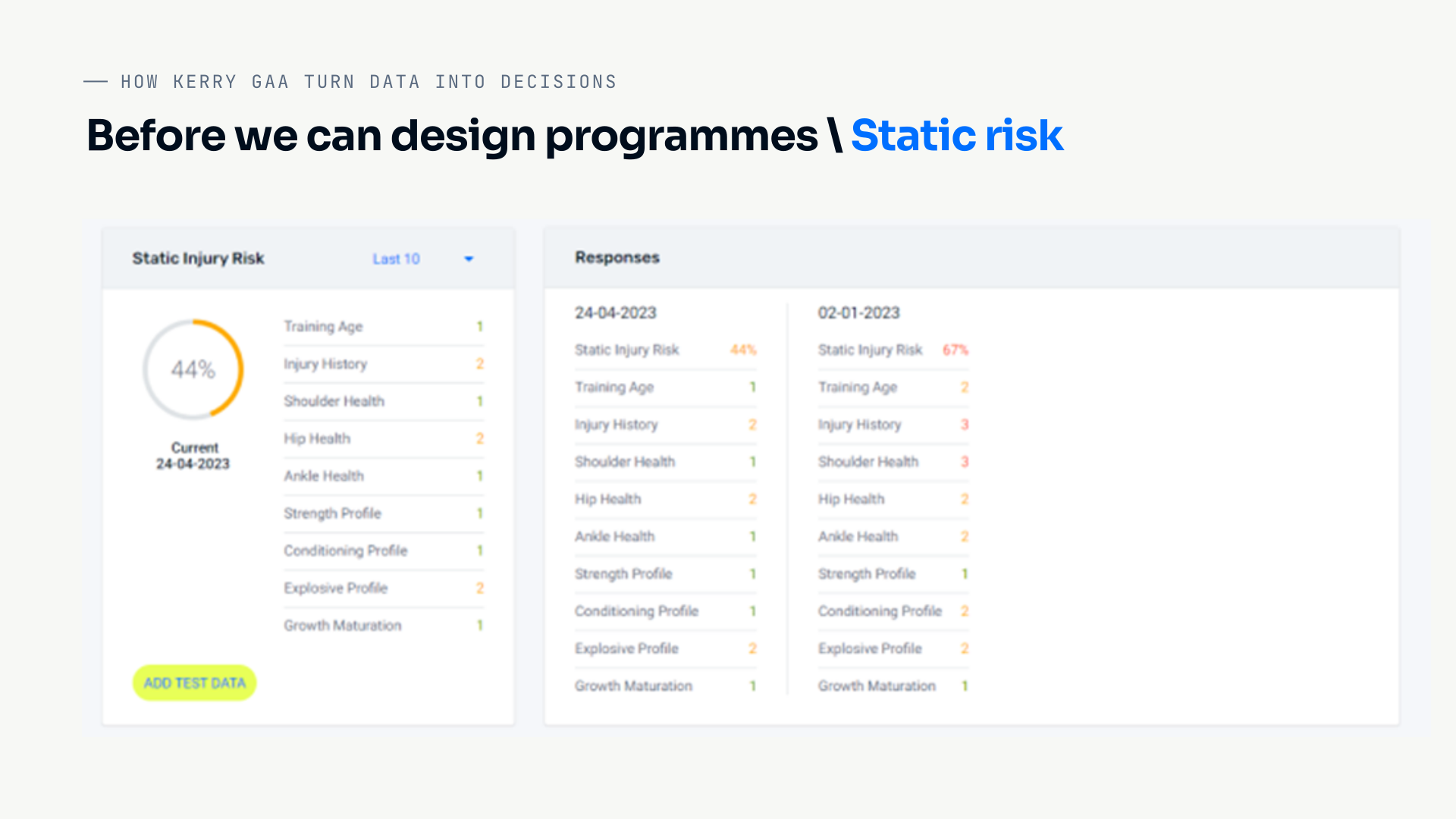
Part of Kerry’s injury risk work is built on an article by Dr Eamonn Flanagan on modern injury risk factors, which set out six areas where risk is highest. Jason has adapted that to Kerry rather than adopting it whole.
“We’ve kept injury history, age, but instead of, maybe they were looking at hip health or concussion, we changed that to hamstring health and strength. We looked at strength, so that’s our mid-thigh pull. And then I looked at our conditioning, and we’re using our 1.2 for that, and our explosive profile, so we look at our CMJ for that.”
Taking each in turn.
Injury history
Jason’s position is that this remains the strongest single predictor, and that recent data analytics work hasn’t displaced it.
“The previous injury history is still the strongest predictor of future injury. Especially for hamstrings, groins, knees, and ankle joints.”
Concussion
Kerry don’t currently score this, but Jason flags it as something that may need to be added, partly because of rule changes increasing contact in the middle of the field. He cites figures from other sports: in his words, a concussed rugby player carries roughly a 60% likelihood of a lower limb injury within 90 days, American football a 150% increased chance of a strain within the same window, and recent research in soccer around a 50% chance of injury by the end of a season.
“Concussion is definitely something that’s a hot topic at the minute with the GAA. So it’s something that we definitely will have to look at.”
Age
Drawing on Tim Gabbett’s work with Australian Football League players, Jason notes that the risk sits at both ends rather than only with older players.
“He’s looking especially at the young players coming in, the rookies. They might have their strength base built up, they might have their aerobic base built up, but also then he says, with players that have been in the system for seven plus years, there’s a high probability of injury.”
Strength
The argument here is that strength is protective, and that the research supporting it is reasonably consistent.
“The players that were high in strength gains were able to cope with a lot more workload and were having a lot fewer injuries than players that were less strong in a squat.”
Hamstring strength
is separated out as its own factor, drawing on David Opar‘s work on hamstring strength and injury.
Explosive profile
Jason is careful about this one, and says so.
“As Eamonn in the article has alluded to, there’s not a whole pile of research saying that the explosive profile is going to be as strong a predictor. But the explosive athletes, just around logic, athletes with more fast twitch muscle fibres are more at risk and maybe need to be monitored accordingly.”
The practical consequence is that the players carrying most risk on this measure tend to be the ones a team can least afford to lose.
“Those athletes, more explosive athletes, they’re going to give out more high speed running, more sprint distance, more sprints, higher velocities, jump higher, cut more. So they tend to be our top athletes. So you tend to be wary of watching them and keeping an eye on them.”
Together these make up what Kerry call static risk, a picture of what a player brings into a phase of the season before any training has happened.
Dynamic risk
What moves week to week is also handled through RYPT.
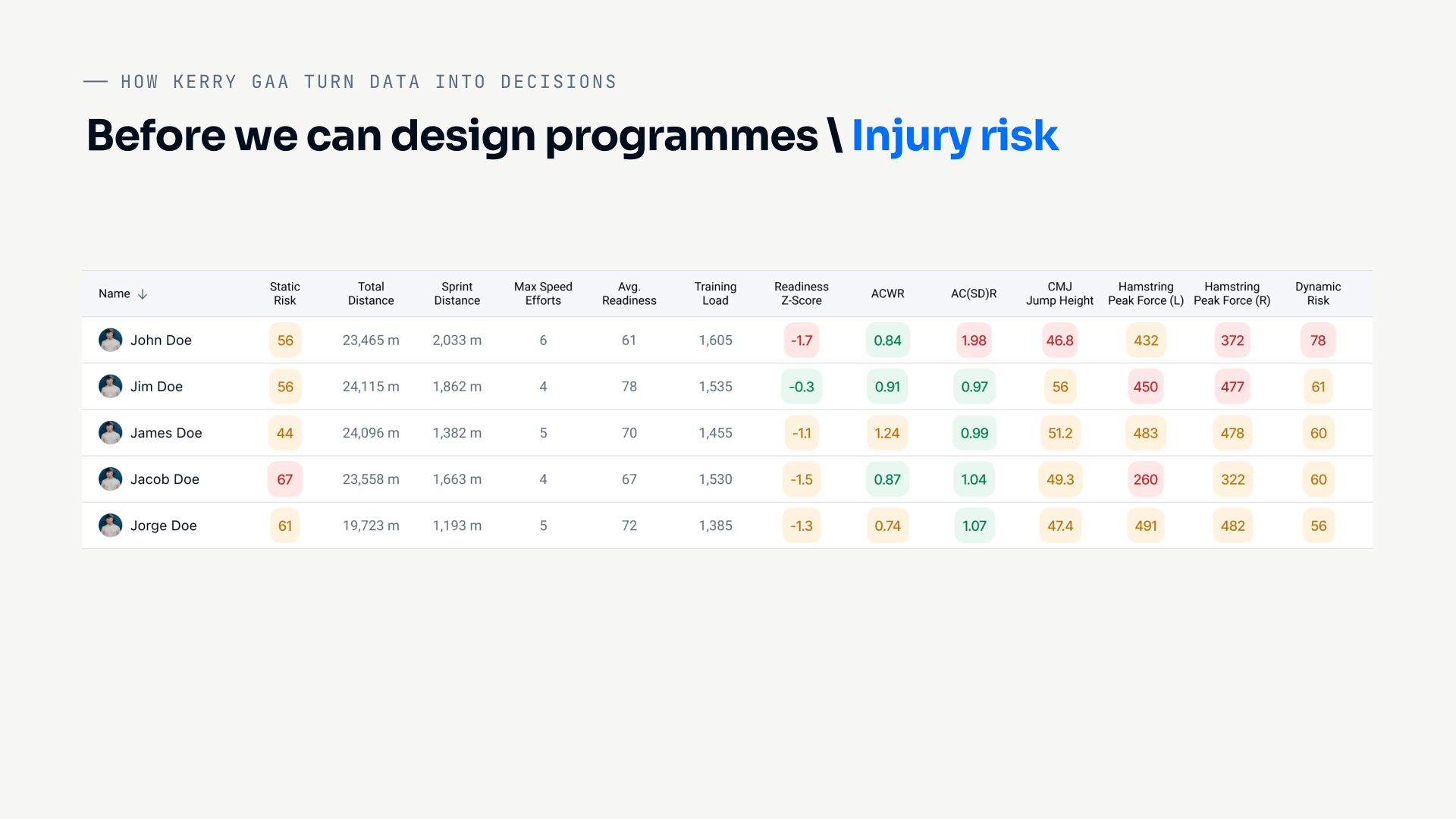
“The static risk will be set for that phase of the year, but then, this is all in RYPT, so the dynamic risk is then what we take into account as their GPS, their external loads. We take in their wellness, we take in their internal loads which we monitor through RYPT, and then we look at the acute and chronic and the Z scores, their readiness. And then we get also their performance markers, be it hamstring and CMJ.”
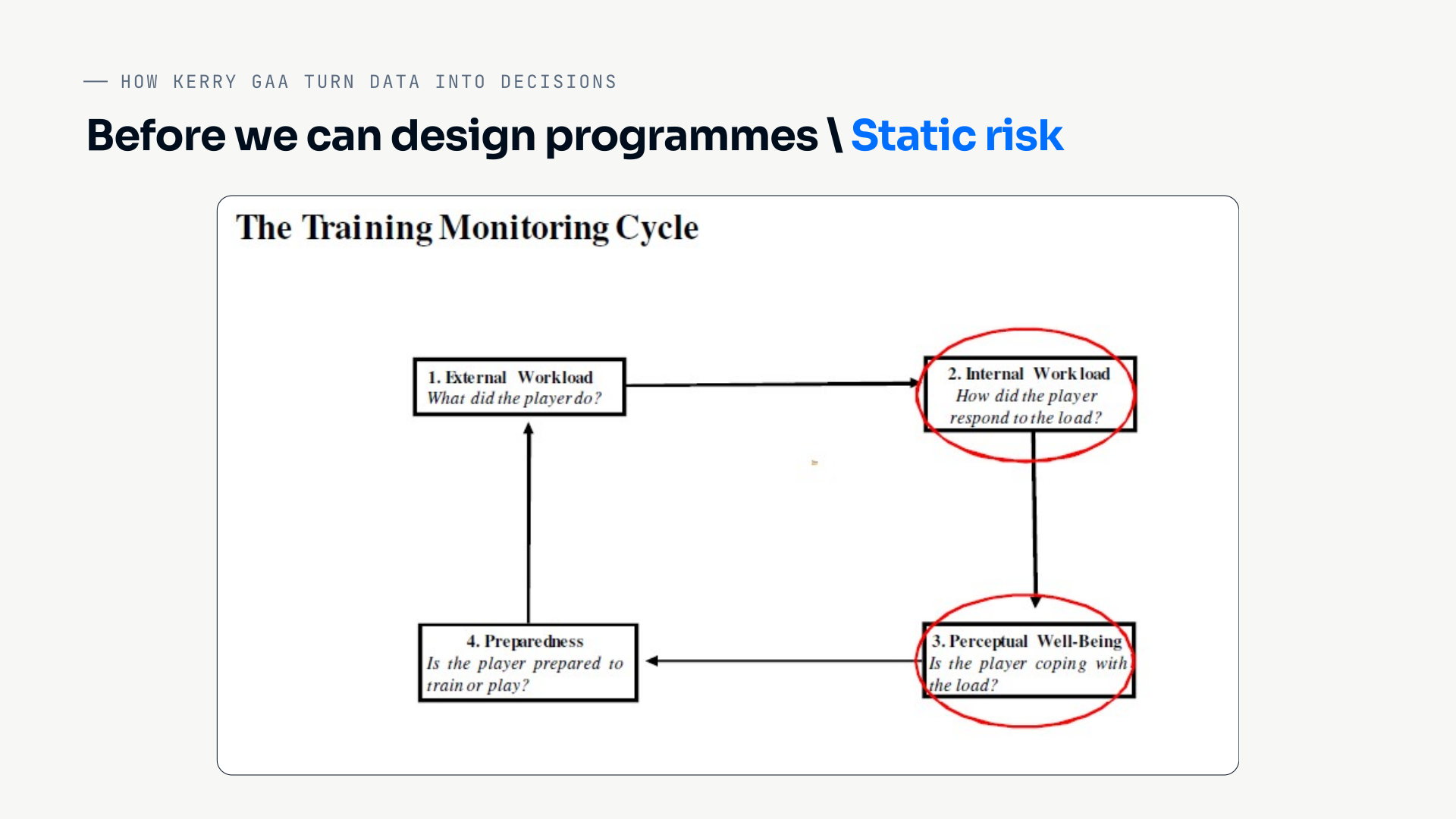
The structure behind it is the training monitoring cycle: what the player did, how they responded to it, whether they are coping with it, and whether they are prepared to train or play.
The two scores are read against each other rather than in isolation, and the combination is what identifies a player worth attention.
“The players that have got a high dynamic risk, we look at then where they sit with their static risk, and who’s at high risk then.”
This is the point at which Jason is most careful, because a flag isn’t a decision.
Interpreting the data
The through line in everything Jason covered is that the system produces a flag and a person makes the decision, and that those aren’t the same thing.
His closing points are about how to hold that position in practice.
“Knowing what you’re measuring with all the profiles. Consider the context when you’re reporting GPS to others, and keeping it very simple. Optimise loading, not necessarily unloading. And also keeping it very simple when it comes to data, more things should not be used than are necessary. And then just keep asking questions around the data.”
Having everything in one system doesn’t change that, and Jason makes the point directly about the integration between RYPT and VALD.
“How we are now with the likes of VALD integrated and GPS integrated into the RYPT system, we’ve got a one-stop shop, but you just don’t take the data as gospel. Keep asking questions around the data and keep listening to your gut, and your eyes. Your eyes are going to tell you a lot more with the player, and asking and talking.”
The analysis ends up functioning as a conversation rather than a verdict, both with the player and with the rest of the performance staff.
“It’s a way of communicating to the player, but also a way of communicating to the rest of the performance staff around the athlete, and just keep asking questions, both with the player and with the performance staff.”
What the players see
Asked how Kerry manage the players’ relationship with the data, Jason’s answer is that they see their own, and see it immediately.
“They get to see their own GPS on RYPT. They go into their own profile, they can see everything from week to week, month to month, how they’re performing. It’s instant, with StatSports the GPS goes straight up, VALD data goes straight up. So once they do that they can see it straight away on their app and their phone.”
What they don’t see is the injury risk picture, which stays with the performance staff.
Wellness monitoring
Kerry’s wellness monitoring came out of Jason’s own PhD work on internal load in GAA players, where wellness was collected daily. They’ve since reduced that to field session mornings, in part to protect compliance, which he notes runs above 80%, higher than much of the published research with professional teams.
The reason for collecting it is less about the numbers than about who to talk to.
“It’s hard to talk to 35 players and know where they are on a daily basis as they come in for training on the field. So if we get them to fill that in, then it gives us an idea of where boys are at, and then who are the key boys that we need to touch base with.”
From there it may lead to a test, a jump or hamstring measure, an intervention with the physios, or a modified session.
“It’s all down to communication. It’s a communication tool to open up the door for talking and just finding out where the athlete is.”
Watch the full conversation
The full 30 minute session, including the audience questions, is available to watch back.
Jason McGahan is High Performance Manager with Kerry GAA. Conor Tierney works in Health and Human Performance with VALD. Cormac O’Beirne is CEO and Co-founder of RYPT.
ForceDecks and NordBord results feed directly into RYPT, so a player’s testing history sits in the same record as their training, wellness, and availability data.


What are you waiting for?
Talk to our team and see how RYPT can help you






Want to leave a comment about this article?
Your email address will not be published. Required fields are marked *