

How to Accurately Measure Standing Height: A Guide

[3-min read]
Being able to measure standing height accurately is essential for various health assessments and anthropometric studies, including growth and maturation. This guide provides a step-by-step procedure for two methods you can use to accurately measure standing height, the stadiometer method, and the wall-marking method.
Option #1 / The Stadiometer Method
The stadiometer method is the most accurate method to measure standing height and is based on the International Standards for Anthropometric Assessment (ISAK).
Required Equipment
- A Stadiometer: Ideally, this should be a wall-mounted stadiometer. Ensure it is calibrated and securely fixed to the wall. If you don’t have access to a wall-mounted stadiometer, a free-standing stadiometer will suffice.
- A Flat, hard surface: The floor must be level and firm to avoid inaccuracies in measurement.
- A partner: to take the measurement.
Preparation Steps
- Choose the Right Environment:
- Suitable Lighting: Select an area with adequate lighting.
- Suitable Surfaces: Ensure there is a flat wall with no obstructions, and a flat hard floor surface to avoid inaccuracies in measurements.
- Dress Appropriately:
- Light Clothing: You should wear shorts and a t-shirt to avoid interference from bulky clothing.
- No Hats or Hair Accessories: Shoes, hats, and any hair accessories that may affect the measurement should be removed.
Measurement Procedure
- Positioning:
- Stand with your heels together, feet flat on the ground, and arms relaxed at your sides.
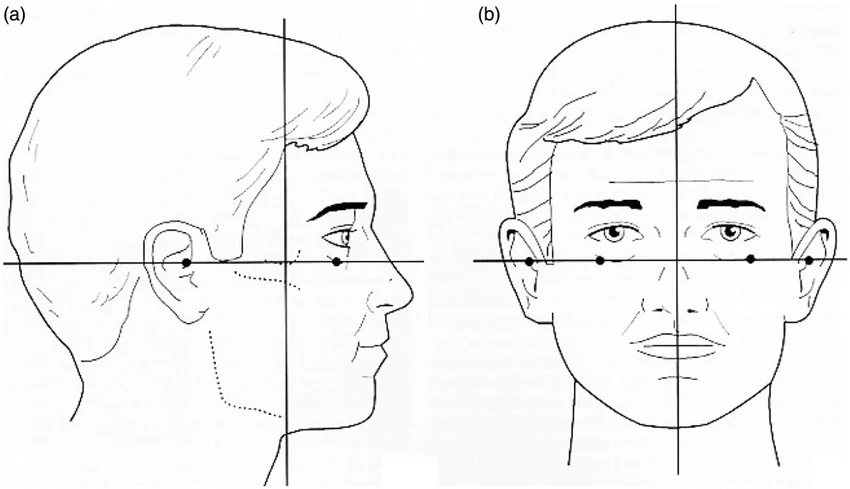
- Ensure that your back, buttocks, and head are touching the stadiometer. Your head should be in the Frankfort Plane, meaning the lower edge of your eye socket should be level with the notch above your ear (tragus) as pictured below.
- Take the Measurement:
- Your partner should lower the horizontal headpiece of the stadiometer gently until it touches the crown of your head.
- Making sure not to compress your hair or head; it should rest lightly on top.
- Record Your Height:
- Your partner should read the measurement at eye level to avoid parallax error.
- Record your height in centimeters (cm) for accuracy.
- Repeat for Accuracy:
- For reliability, repeat the measurement two more times.
- If there is a discrepancy greater than 0.5 cm between measurements, take additional readings until consistent results are achieved.
Option #2 / The Wall Marking Method
If you don’t have access to a stadiometer the wall marking method is a straightforward method that requires minimal equipment and can measure standing height accurately.
Required Equipment
- A Measuring Tape
- A hard, flat object: like a book or a cereal box
- A Pencil or Marker
- A Flat, hard surface: The floor must be level and firm to avoid inaccuracies in measurement.
- A partner: to take the measurement.
Preparation Steps
- Choose the Right Environment:
- Suitable Lighting: Select an area with adequate lighting.
- Suitable Surfaces: Ensure there is a flat wall with no obstructions, and a flat hard floor surface to avoid inaccuracies in measurements.
- Dress Appropriately:
- You should wear shorts and a t-shirt to avoid interference from bulky clothing.
- Shoes, hats, and any hair accessories that may affect the measurement should be removed.
Measurement Procedure
- Positioning:
- Stand with your heels together, feet flat on the ground, and arms relaxed at your sides.
- Ensure that your back, buttocks, and head are touching the stadiometer. Your head should be in the Frankfort Plane, meaning the lower edge of your eye socket should be level with the notch above your ear (tragus) as pictured above.
- Mark Height:
- Your partner should place the flat object held horizontally on top of your head at a right angle to the wall.
- Lightly mark the wall at the point where the object touches it.
- Take the Measurement:
- Your partner should use a measuring tape to measure the distance from the floor to the mark on the wall. You should assist your partner by holding the measuring tape on the floor against the wall.
- Record Your Height:
- Your partner should read the measurement at eye level to avoid parallax error.
- Record your height in centimeters (cm) for accuracy.
- Repeat for Accuracy:
- For reliability, repeat the measurement two more times.
- If there is a discrepancy greater than 0.5 cm between measurements, take additional readings until consistent results are achieved.
Conclusion
By following these steps you’ll ensure that you measure standing height accurately according to ISAK standards.
Did you enjoy this article?

If so, then please share it
About RYPT
RYPT is an athletic development software platform designed to help multi-disciplinary coaching teams deliver athletic development programs and monitor performance efficiently, at scale.
RYPT helps coaching teams manage every aspect of their coaching relationship from delivering individualized training plans, to monitoring readiness and workload, to tracking growth and maturation, menstrual cycle, and injuries. Centralizing data and streamlining communication to help coaches reduce injury risk and optimize performance.
Over 4,000 coaches worldwide, working from grassroots to Olympic level, trust RYPT to deliver their athletic development programs and monitor their athletes. RYPT supports individual coaches, sports teams, private gyms and academies, schools and universities, and large sporting organisations.

What are you waiting for?
Talk to our team and see how RYPT can help you






Want to leave a comment about this article?
Your email address will not be published. Required fields are marked *