
How to Maximise the Off-Season: Purpose, Structure, and Theoretical Foundations

[4-min read]
In sports science, the annual training plan is designed according to the principles of periodisation, a systematic approach that organises training into distinct phases to optimise performance and recovery. Within this framework, the off-season, also known as the transition phase, plays a vital yet often undervalued role in the athlete’s long-term development (Balyi, 2004). This period occurs between the conclusion of one competitive season and the beginning of the preparatory phase of the next. Its primary objectives are to facilitate physiological recovery, psychological regeneration, and general physical preparation, thereby ensuring the athlete’s readiness for the forthcoming training cycle. This blog examines the purpose, structure, and theoretical underpinnings of the off-season, drawing on foundational and contemporary periodisation literature, to help you maximise the off-season with your athletes.
Maximise the Off-season / What is the Purpose of the Off-Season?
The off-season serves as a critical period for both restoration and renewal. Following months of competition, athletes often experience cumulative fatigue, muscular microtrauma, and psychological strain. According to Bompa and Buzzichelli (2019), the transition phase aims to:
“promote complete physiological and psychological recovery while maintaining a minimal level of physical conditioning.”
This recovery is essential for preventing overtraining and optimising long-term performance capacity.
From a physiological perspective, the off-season allows the body to repair and regenerate. The temporary reduction in training intensity facilitates the restoration of muscle tissue, hormonal balance, and neuromuscular efficiency (Issurin, 2010). It also allows for the correction of biomechanical imbalances that may have developed during competition.
Equally important is the psychological regeneration that occurs during this phase. Competitive sport imposes significant cognitive and emotional demands, often leading to mental fatigue and diminished motivation. Bompa (1999) emphasises that psychological recovery is indispensable for sustaining athlete engagement across multiple competitive cycles. Periods of unstructured activity, leisure, and social engagement contribute to emotional renewal and the restoration of motivation.
A further objective of the off-season is injury rehabilitation and correction. This phase provides time for targeted interventions addressing chronic injuries or technical inefficiencies (Kiely, 2018). Corrective exercises and physiotherapy are integrated into training to restore functional movement patterns and prevent future injuries.
Finally, the off-season emphasises general physical preparation, a return to fundamental fitness qualities such as aerobic endurance, flexibility, and basic strength. Unlike the competitive season, where sport-specific performance dominates, this period builds a broad athletic foundation that underpins future technical and tactical work (Bompa & Buzzichelli, 2019). All of these factors must be taken into account in order to maximise the off-season.
Maximise the Off-season / Structure and Duration of the Off-Season
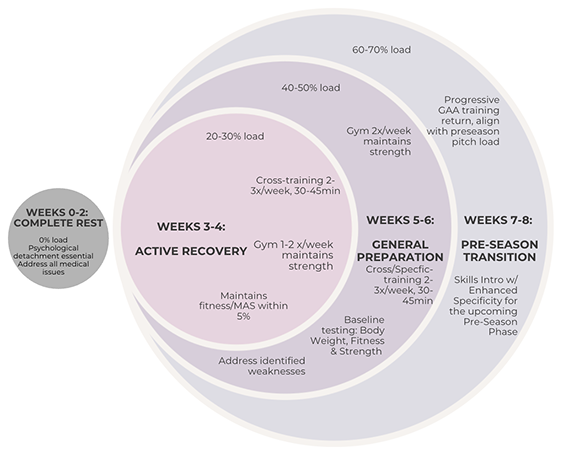
The off-season typically consists of three subphases: the active rest phase, the general preparation phase, and the pre-season transition phase.
The Active Rest Phase
The active rest phase, lasting approximately two to four weeks, prioritises rest and rejuvenation. Athletes engage in low-intensity recreational activities, such as swimming, cycling, or hiking, that maintain basic fitness without imposing significant physiological stress. Total inactivity is discouraged, as it can lead to detraining and a loss of basic fitness adaptations (Issurin, 2010).
The General Preparation Phase
Following this, the general preparation phase begins, usually spanning four to eight weeks. The emphasis shifts toward structured yet moderate training focused on developing general strength, aerobic capacity, and mobility. Technical refinement and corrective drills are often incorporated at this stage. The workload gradually increases in volume and intensity, preparing the athlete for the demands of the upcoming pre-season.
The duration of the off-season varies by sport and competition level, typically ranging from four to twelve weeks. Professional athletes in high-demand sports, such as football or basketball, may require longer recovery phases due to dense competitive schedules. In contrast, amateur or developmental athletes often have shorter off-seasons, aligning with institutional calendars (Balyi & Hamilton, 2004).
The Pre-season Transition Phase
The pre-season transition phase bridges general preparation and pre-season training. Training becomes increasingly sport-specific, with higher-intensity sessions, technical elements, and competitive drills introduced progressively (Bompa & Haff, 2009). Volume maintains or decreases while intensity rises toward pre-season levels. Strength training shifts from hypertrophy work to explosive, power-based movements, and conditioning becomes sport-specific.
To learn more about how to maximise the off-season for your team, join our free webinar on Monday the 3rd of November, where Jason McGahan PhD and Fionn O’Shea PhD(C) will be sharing their knowledge and experience of planning off-season training, from the latest research in the area. As well as sharing practical takeaways around structuring and implementation, and resources you can use with your team to maximise the off-season.
Maximise the Off-season / Theoretical Foundations
The concept of the off-season is rooted in the periodisation model of training, first formalised by the Soviet theorist L. P. Matveyev (1964) and later expanded by Tudor O. Bompa. Periodisation theory posits that systematic variation in training load across defined phases—preparatory, competitive, and transition—promotes optimal adaptation and performance. The off-season, or transition phase, represents the final stage of the annual cycle and serves as a bridge to the next macrocycle.
Bompa and Buzzichelli (2019) describe the transition phase as essential for ensuring “adaptive continuity.” Without sufficient recovery, the accumulation of fatigue may impair physiological adaptations and increase the likelihood of injury or burnout. Moreover,
Kiely (2018) argues that modern periodisation must accommodate individual variability, suggesting that off-season strategies should be flexible, athlete-centered, and responsive to contextual factors such as age, workload, and competition demands.
The integration of the off-season within the broader periodisation framework underscores its strategic importance: it is not a period of inactivity but a planned phase of regeneration and foundation building, essential to the cyclical nature of peak performance.
Conclusion
In summary, the off-season constitutes a fundamental component of the athlete’s annual training plan, facilitating recovery, rehabilitation, and holistic preparation. Grounded in the principles of periodisation, it functions as a transitional bridge that allows athletes to regenerate physically and mentally while maintaining the base fitness required for subsequent training. When effectively structured, the off-season enhances long-term athlete development, minimises injury risk, and sustains motivation across competitive cycles. As modern sport continues to demand higher levels of performance and year-round competition, your ability to maximise the off-season remains vital for athletic longevity and success.
Part two of this two-part blog to help you maximise the off-season translates these principles into a practical, evidence-based training programme specifically designed for GAA athletes. This 8-week off-season plan integrates these core objectives: physiological recovery, psychological regeneration, general physical preparation, and injury prevention into a structured training plan that balances sport-specific preparation, conditioning, aerobic and strength development. Click here to read it.
Did you enjoy this article?

If so, then please share it
About RYPT
RYPT is an athletic development software platform designed to help multi-disciplinary coaching teams deliver athletic development programs and monitor performance efficiently, at scale.
RYPT helps coaching teams manage every aspect of their coaching relationship from delivering individualized training plans, to monitoring readiness and workload, to tracking growth and maturation, menstrual cycle, and injuries. Centralizing data and streamlining communication to help coaches reduce injury risk and optimize performance.
Over 4,000 coaches worldwide, working from grassroots to Olympic level, trust RYPT to deliver their athletic development programs and monitor their athletes. RYPT supports individual coaches, sports teams, private gyms and academies, schools and universities, and large sporting organisations.
References
- Balyi, I., & Hamilton, A. (2004). Long-term athlete development: Trainability in childhood and adolescence. Canadian Sport Centres.
- Behm, D. G., & Chaouachi, A. (2011). A review of the acute effects of static and dynamic stretching on performance. European Journal of Applied Physiology, 111(11), 2633-2651.
- Bompa, T. O. (1999). Periodization: Theory and methodology of training. Human Kinetics.
- Bompa, T. O., & Buzzichelli, C. (2019). Periodization: Theory and methodology of training (6th ed.). Human Kinetics.
- Bompa, T. O., & Haff, G. G. (2009). Periodization: Theory and methodology of training (5th ed.). Human Kinetics.
- Hickey, J., et al. (2014). The efficacy of a 4-week concurrent training programme on neuromuscular and aerobic function in GAA players. Journal of Strength and Conditioning Research, 28(3), 793-801.
- Issurin, V. B. (2010). New horizons for the methodology and physiology of training periodization. Sports Medicine, 40(3), 189-206.
- Kiely, J. (2018). Periodization theory: Confronting an inconvenient truth. Sports Medicine, 48(4), 753-764.
- Laursen, P. B., & Buchheit, M. (2019). Science and application of high-intensity interval training. Human Kinetics.
- Matveyev, L. P. (1964). Periodization of sports training. Fizkultura i Sport.
- Roe, M., et al. (2018). A six-stage operational framework for individualising injury risk management in sport. Injury Epidemiology, 5(1), 1-8.
- Schoenfeld, B. J., et al. (2016). Effects of resistance training frequency on measures of muscle hypertrophy: A systematic review and meta-analysis. Sports Medicine, 46(11), 1689-1697.
About the author
Jason McGahan
Jason is Head of Athletic Performance at Kerry GAA. Jason has over 15 years’ experience working as an S&C Coach/Sports Scientist with elite international professional and amateur athletes within several high-performance teams. He holds an MSc in Sports Performance, a UKSCA Accredited Strength and Conditioning Coach, and ASCA Coach. He recently completed a Ph.D. in Applied Sport Science, with special reference to training load, its impact on training practice and performance. Jason has been published in several peer-reviewed strength and conditioning journals and has presented at national and international conferences.

What are you waiting for?
Talk to our team and see how RYPT can help you






Want to leave a comment about this article?
Your email address will not be published. Required fields are marked *