

Pre-Season in Gaelic Football: New Rules, Key Principles, Game Models, and How to Maximise Training

[11-min read]
In Gaelic football, the success of a season rarely begins in April or July. It begins in December, when the structure, culture, and conditioning of a team are forged. The purpose of pre-season is clear: to increase the conditioning base, develop strength and power, prevent injury, and integrate tactical and physical preparation. Yet, with the 2025 GAA rule amendments, potentially, there is an altered rhythm to the pre-season phase for coaches to manage. The aim of this blog is to assess the potential impact of the FRC’s rule amendments and provide coaches with some key principles of training design to maximise the pre-season period within Gaelic Football at elite or sub-elite levels.
Gaelic Football is best described as an invasion field sport that consists of repeated high-speed locomotion following the ebb and flow of the game (Malone et al., 2017; Boyle et al., 2023). The main technical skills executed by players during match-play include kicking of the ball both short and long distances, high catching, handling, hand-passing, the ‘solo’ (kicking the ball to oneself and collecting it before it bounces), intercepting an opponent’s pass from hand or foot, or an opponent’s shot on goal, and blocking (McGahan et al., 2020; Malone et al., 2021). Tackling and bodily contact is also permitted via hand on ball, or shoulder on shoulder contact to compete for possession (Cullen, McCarren and Malone, 2021). Modern Gaelic football performance is underpinned by a blend of physiological, physical, and technical-tactical capacities.
Players must possess sufficient aerobic power (VO₂max), efficient energy utilisation, and running economy to tolerate sustained high-intensity demands, while also managing lactate and cardiovascular stress. Physically, success depends on the ability to repeatedly express strength, power, acceleration, and high-speed running, including exposure to maximal velocity efforts. Crucially, these qualities must be durable and repeatable across the game (Malone and Cullen, 2021). Overlaying this is technical and tactical excellence, decision-making under pressure, off-shoulder running, score creation, and effective tracking and tackling, all executed at speed and under fatigue (Malone and Cullen, 2021).
The pre-season represents one of the most valuable yet often misunderstood phases within team sports such as Gaelic football. For the performance scientist and coach, it’s the one window in the year where load can be accumulated, physical qualities developed, and tactical clarity established without the constraints of competitive recovery (Bompa & Haff, 2009; Fisher et al., 2022), furthermore it is known that those players who accumulate more loading and sessions within the pre-season period typically are at relative lower injury risk (Murray et al., 2017; Fisher et al., 2022).

Figure 1. The Gaelic Football playing field, dimensions and playing positions during match play
Is the Game Changing? Implications of the 2025 Rule Amendments
The 2025 season introduced a suite of rule amendments aimed at increasing game dynamism and spectator appeal, directed by the Football Review Committee. These changes promote a more attacking style, with implications for player performance demands. Central is the new 40 m scoring arc (Figure 1), awarding two points for long-range scores, incentivising distance shooting and strategic positioning. The “solo and go” rule allows a fouled player to restart immediately with a solo run, increasing fluidity and pace while reducing stoppages.
Structural regulations now require at least three outfield players in both defensive and offensive halves, curbing ultra-defensive systems and potentially increasing running demands on half-backs, midfielders, and half-forwards. Kick-outs must now travel beyond the 40m arc, while passing back to the goalkeeper has been restricted, both designed to limit lateral play and encourage forward momentum.
Collectively, these reforms mark a shift toward a faster, more engaging, and skill-oriented game in line with the GAA’s vision. At present, only anecdotal evidence exists regarding their impact, though preliminary analyses (Figures 2 and 3) suggest some alterations in running performance between the 2024 and 2025 seasons (Malone et al., 2025, Unpublished Observations).
These evolving tactical and physical demands appear to fall within the natural game-to-game variation of these measures; as such, they fail to represent a significant or meaningful change. There is still debate as to the need for practitioners to adapt conditioning and periodisation strategies to prepare players for the apparent altered rhythms and intensities of competition. Irrespective of these running demands, practitioners should aim to:
utilise the pre-season must build greater repeatability, robustness, and recoverability to meet the required locomotor demands of the game model that the coach and management want to employ (Burgess et al., 2022)

Figure 2. The alteration in running performance demands for Elite Gaelic Football with respect to the FRC rule amendments presented as absolute performance across positional lines. TD: Total Distance; HSR: High Speed Running (m ≥ 19.8 km⸳h-1); HI Speed Effort (number of efforts ≥ 19.8 km⸳h-1); Explosive: Explosive Distance (Acceleration (≥ 3 m⸳s-2) and Deceleration (≥ -3 m⸳s-2) distance; Accel: Total Acceleration efforts (number ≥ 3 m⸳s-2); %Vmax: Percentage maximal velocity.
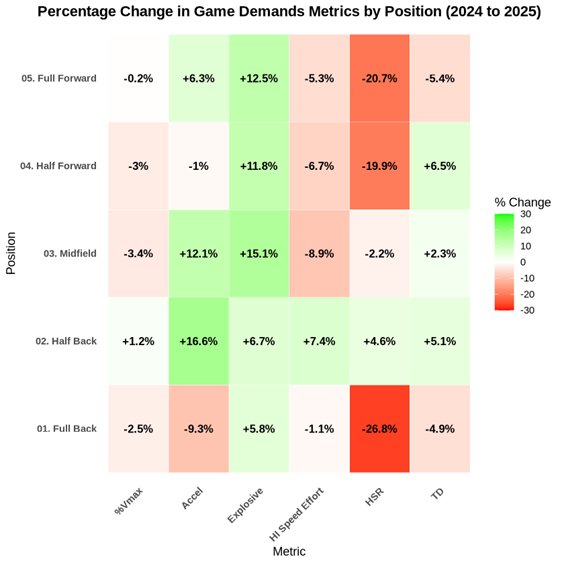
Figure 3. The alteration in running performance demands for Elite Gaelic Football with respect to the FRC rule amendments presented as a percentage change across positional lines. TD: Total Distance; HSR: High Speed Running (m ≥ 19.8 km⸳h-1); HI Speed Effort (number of efforts ≥ 19.8 km⸳h-1); Explosive: Explosive Distance (Acceleration (≥ 3 m⸳s-2) and Deceleration (≥ -3 m⸳s-2) distance; Accel: Total Acceleration efforts (number ≥ 3 m⸳s-2); %Vmax: Percentage maximal velocity.
Principles of Pre-Season Design
Pre-season physiologically represents a structured period of overload (Bompa & Haff, 2009; Daniels et al., 2019; Burgess et al., 2022), where athletes’ physiological, psychological, technical and tactical bases are built. The aims of pre-season, regardless of the sport or level of play, are as follows:
- Increase the conditioning base of all players
- Develop strength and power
- Reduce injury risk through progressive overload
- Integrate technical, tactical, and physical components
- Prepare position-specific conditioning profiles
A structured, integrated approach is key.
A successful pre-season doesn’t just build fitness. It should aim to create an adaptable, durable athlete capable of sustaining tactical execution at high intensity across 70 minutes and beyond.
To learn more about how to maximise the pre-season for your team, join our free webinar on Monday, the 19th of January, where Neil Welch, PhD, and Shane Malone, PhD, will be sharing their knowledge and experience to help you maximise the pre-season period. They’ll be taking a detailed look at the demands of Gaelic Football under the FRC’s rules amendments, and providing some key principles of program design to guide you in your pre-season planning.
Periodisation: From General to Specific
Pre-season typically spans 6-10 weeks, progressing from a general preparatory phase (GPP) to specific preparatory (SPP) and pre-competition (PC) phases. For this blog, we will focus on the on-pitch and conditioning elements.
Weeks 1-4 (GPP)
Focus: Aerobic Capacity. This is achieved via tempo work, long interval and short interval work. Mainly through generic conditioning processes to build up volumes and introduce high-speed running (HSR) exposures over time to prepare players for the return to pitch. Within developmental warm-ups, players will progress change of direction (CoD), acceleration, deceleration, and maximal speed work progressively.
Weeks 4-6 (SPP)
The aim of SPP is to begin to build total weekly volumes and reintroduce the specific game model of the team to players again from an attack, defence, set play and transition perspective, in tandem with improving the generic conditioning base of your players.
Re-introduction to pitch work through general skill work, via skills stations, which are paired with generic running. Coaches should also begin to introduce game-based conditioning (SSG-MSG). Depending on athletic development needs, specific athletes will complete top-up conditioning as required through tempo work, short interval work, and some game-specific worst-case scenario blocks.
Weeks 6-10 (PC)
SSG and MSG transition and are incorporated with LSG and full-simulated match segments within training in line with the team’s game model, emphasising match-specific drills. Top-up conditioning is completed via Tempo running, Short Intervals, Short intervals with change of direction, Football-specific conditioning, and additional SSG work, as required.
Load Progression and Monitoring
The fitness-fatigue model applies acutely in pre-season. If load ramps too aggressively, soft-tissue injuries rise; too little, and in-season stress overwhelms players. GPS, session RPE, and HR monitoring allow practitioners to manage this relationship.
Typical load targets across a weekly cycle that would progress in a safe manner include:
- Total Dist. Volume: 1.5-2.5x match total load volume per week (Malone et al., 2021).
- HSR Volume: 1.5–3.0x match total load volume per week (Malone et al., 2021).
- Acceleration and Deceleration Volume: 1.5-3.5x match total load volume per week (Malone et al., 2021).
- Maximal Speed Exposure: Build players towards 3 to 4 rolling 10-day exposures at 90% Vmax (Malone et al., 2017).
- Heart Rate monitoring: Building players’ time over 90% HRmax. Each additional 10 minutes over 90% results in a 1-2% gain in aerobic capacities (Bucheitt et al., 2025; Malone and Buchheit, 2025).
Coaches should review weekly load reports to ensure gradual progression while integrating technical and tactical objectives. It is important to monitor the weekly changes in load and try as best as possible to progress loading safely within the 10-15% range (Gabbet et al., 2020).
Conditioning for the Modern Game
Elite Gaelic footballers cover 7,000-11,000m per game, depending on positional line of play, with approximately 10-12% of this distance completed at high speed (≥ 5.5 m/s) with peak match velocities reaching 90% of players’ maximal speed at regular intervals (Malone 2025, unpublished observations). While the new rules appear to have increased open play, locomotor running demand figures are still within the typical profiles for most teams.
Therefore, as before, we must aim to condition players to meet the demands of the game model that is implemented by the team and not be distracted by media rhetoric that will distract us from developing the physiological reserves to allow our players to create the winning moments for our teams when they matter most (Burgess, 2022).
It is important to maintain a structured, principle-based approach when conditioning the modern game. As such, we must simulate the game’s natural fluctuating intensities and durations through the combined use of the generic conditioning continuum below and game-specific conditioning through SSG-LSG (Malone and Cullen, 2021).
The Generic Conditioning Continuum
From a generic perspective, Gaelic Football coaches have five core conditioning tools at their disposal (Malone and Cullen, 2021). Below are the five tools, and some examples of sets and reps that might be completed:
| METHOD | TARGET OUTCOME | TYPICAL PRESCRIPTION SPEED | EXAMPLE |
|---|---|---|---|
| Tempo Intervals | Aerobic Endurance & Recovery | 55-75% Vmax | 3 × 8-14 × 100-110m (20-25 secs on/20-50 secs rest) |
| Long Intervals | Aerobic Capacity & Running Economy | 80-95% MAS | 4 × 400-1,500m (2-4 min rest) |
| Short Intervals | Anaerobic Power & Repeat Speed | 100-130% MAS | 3 × 6-12 (15 secs on/15 secs off) |
| Sprint Intervals | Maximal Velocity Exposure | ≥80%-90% Vmax | 6 × 35-45m (1:6 Work:Rest ratio) |
| Repeated Sprint Intervals | Match-Specific Speed Endurance | Max effort <10 secs | 4 × 6 × 30-45m (15 secs rest) |
During pre-season, the emphasis should shift from longer aerobic-based conditioning early toward short intervals as players approach competition readiness. The only exception here is the use of tempo running, which is a method used throughout the Gaelic Football season to build tolerance to high-intensity conditioning. It must be noted that all generic running should act as a required supplement to football-specific work with the aim of enhancing tissue resilience and minimising inherent injury risk for players (Murray et al., 2017; Fisher et al., 2023).
Small-Sided to Large-Sided Games: Bridging the Science
One of the most powerful tools available to Gaelic Football coaches is the use of sports-specific conditioning through Small-to-Large sided games (Malone et al., 2016; Mangan et al., 2019; Kinnerk, et al., 2025). These games act as a concurrent method of training, enabling practitioners to integrate skill execution, tactical learning, and physiological conditioning within one training environment (McGahan et al., 2020; Malone et al., 2021).
However, it must be noted that no team will maximise their physiological reserves through sports-specific conditioning alone. These games need to be paired with the conditioning continuum above to maximise players’ performance potential within the in-season period (Burgess, 2022; Norman, 2022). Additionally, we must remember that not all SSGs are equal. Their effectiveness depends on how pitch dimensions, player numbers, and rules are manipulated (Malone et al., 2021).
The SSG-LSG Reps Framework
Below is a suggested SSG-LSG framework that provides reference points for balancing technical and physical stimulus for coaches across the pre-season and beyond:
| FORMAT | PLAYERS | TYPICAL PITCH | BOUT DURATION | KEY FOCUS |
|---|---|---|---|---|
| SSG | 1-v-1 to 5-v-5 | 20-40m x 25-35m | 4-8 x 1-3 mins | – Strength – Contact – Collisions – Transitions – Total Dist. – Accel/Decel – CoD |
| MSG | 6-v-6 to 9-v-9 | 50-70m x 40-50m | 4-5 x 4-8 mins | – Tactical Rehearsal – Repeat Speed – Total Dist. – HSR |
| LSG | 10-v-10 to 14-v-14 | 80-120m x 60-80m | 2-4 x 9-15 mins | – Match Conditioning – Game Specific Decision-Making – Specific plays in Attack/Defence – Match Specific GPS Outputs |
Manipulation of Game Variables
- Pitch Size: Larger pitches increase total distance and HSR. Smaller areas emphasise accelerations, decelerations and changes of direction (Malone et al., 2016)
- Player Numbers: Fewer players increase physical load and skill frequency. Larger player numbers will increase contacts and collisions (Bonney et al., 2020)
- Rule Modifications: Introducing two-touch limits, shot clocks, or scoring constraints (e.g. only 40m shots) can replicate match contexts under the new rule setting (Malone et al., 2017)
- Work–Rest Ratio: Start with 1:1 (e.g. 3 min Work:3 min Rest) early in pre-season, progressing toward match-specific 1:3 Work:Rest ratios (Malone et al. 2019)
Combining GPS, RPE and Heart Rate data helps calibrate drills. For example, a 12-v-12 on a half pitch for 8 minutes during the pre-season period might elicit 120 m/min with 12 m/min of HSR, and 4 minutes over 90% HRmax on average, aligning with mid-season match demands.
Your Game Model is the Driver of Performance Preparation
Finally, it is known that the game model is the central reference point that dictates the requirements of play in Gaelic football (Figure 4). This drives your training and match-play outputs and the physiological demands that will be placed on your athletes (Bordonau and Villanueva, 2017).
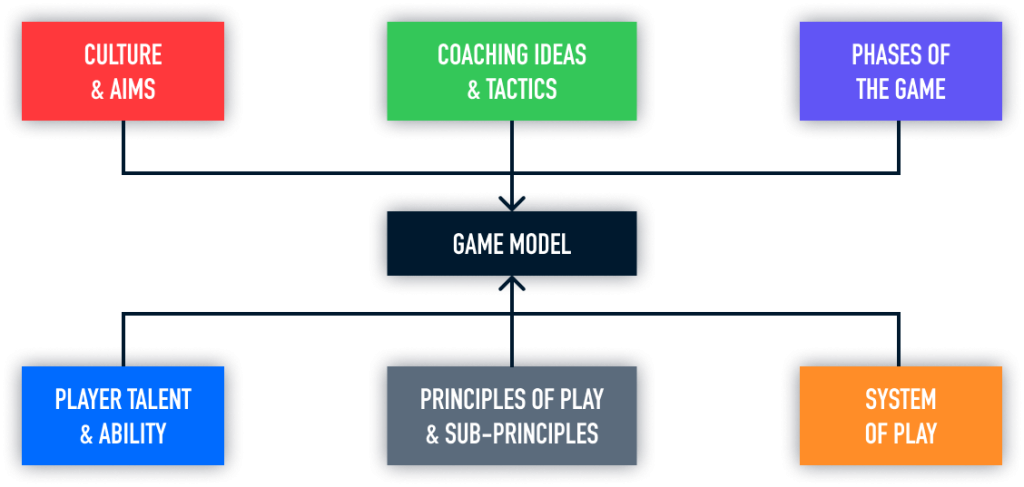
Figure 4. The Game Model within Gaelic Football. Modified from Bordonau and Villanueva, 2017
It defines how a team intends to operate across all phases of the game, attack, defence, both transition moments, and set pieces, while being shaped by coaching philosophy, player talent, a system of play, and cultural aims of the club or county (Bordonau and Villanueva, 2017). Each decision within the game model carries clear physical implications (Figure 5).
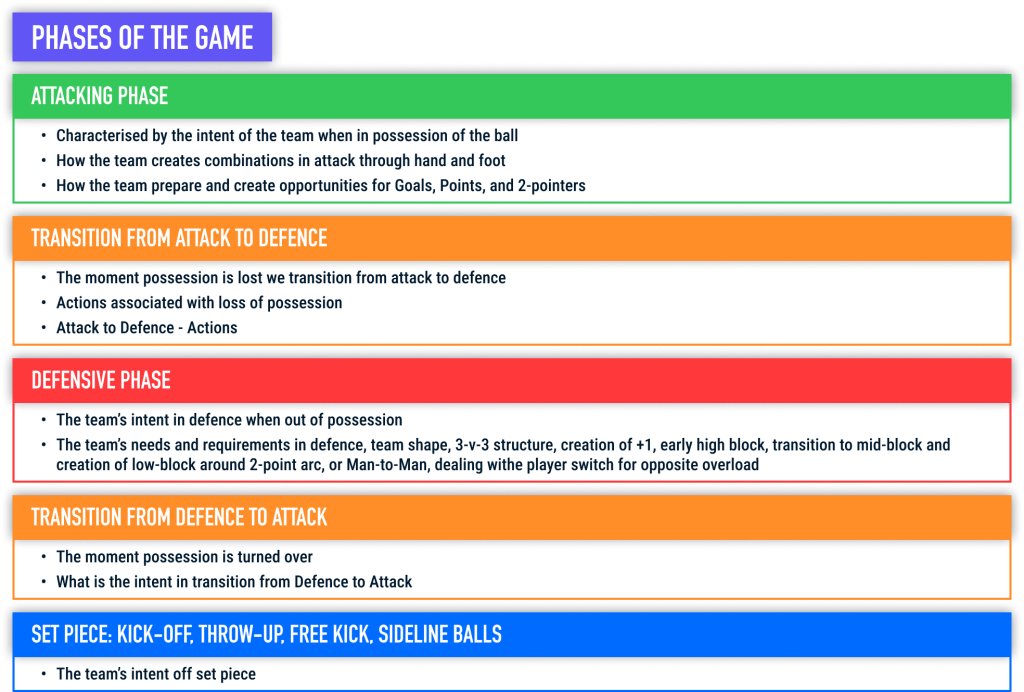
Figure 5. The Phases of the game within Gaelic Football. Modified from Bordonau and Villanueva, 2017
For example, a high press defensive approach with aggressive attack-to-defence transitions demands repeated high-intensity efforts, acceleration capacity, and robust high-speed running tolerance. Whereas a possession-based attacking model places greater emphasis on aerobic efficiency, movement economy, and repeatability under sustained load. Pre-season represents the most critical period to align the entire management group on this game model.
Agreement between the manager, selectors, lead coach, support coaching staff, and conditioning team ensures that physical preparation is a combined model of generic and purpose-built conditioning strategies that serve the tactical and technical intent of the team.
When conditioning staff clearly understand the game model, they can design running, strength, and small-sided game exposures that directly reflect the worst-case scenarios players will face in competition. This alignment allows pre-season loading to maximise physical development, reduce injury risk, and ensure players are truly prepared to express the game model at match intensity when the season begins.
Conclusion
Pre-season within Gaelic Football is not simply a conditioning block, but a strategic period where the foundations of performance, resilience, and tactical clarity are established. The evolving demands of the modern game, influenced by recent rule amendments, reinforce the need for clear alignment between the game model and physical preparation. When coaches and performance staff agree on how the team intends to play, conditioning can be targeted, purposeful, and maximally effective. A well-designed pre-season builds repeatable, durable, and robust athletes who are physically prepared to execute the game model under fatigue, sustain performance across the season, and ultimately deliver when championship moments demand it most.
In the next article, Neil Welch will present guidelines to help you plan your pre-season conditioning.
Did you enjoy this article?

If so, then please share it
About RYPT
RYPT is an athletic development software platform designed to help multi-disciplinary coaching teams deliver athletic development programs and monitor performance efficiently, at scale.
RYPT helps coaching teams manage every aspect of their coaching relationship from delivering individualized training plans, to monitoring readiness and workload, to tracking growth and maturation, menstrual cycle, and injuries. Centralizing data and streamlining communication to help coaches reduce injury risk and optimize performance.
Over 4,000 coaches worldwide, working from grassroots to Olympic level, trust RYPT to deliver their athletic development programs and monitor their athletes. RYPT supports individual coaches, sports teams, private gyms and academies, schools and universities, and large sporting organisations.
References
- Bompa, T.O. and Haff, G.G., 2009. Periodization: theory and methodology of training. 5th ed. Champaign, IL: Human Kinetics.
- Bonney, N., Ball, K., Berry, J. and Larkin, P., 2020. Effects of manipulating player numbers on technical and physical performances participating in an Australian football small-sided game. Journal of Sports Sciences, 38(21), pp.2430–2436.
- Bordonau, J.L.D. and Villanueva, J.A.M., 2018. Tactical periodization: a proven successful training model. SoccerTutor.com.
- Boyle, E., Malone, S., Mangan, S., Doran, D.A. and Collins, K., 2023. Applied sport science of Gaelic football. Sport Sciences for Health, 19(1), pp.27–39.
- Buchheit, M., Akubat, I., Ellis, M., Campos, M., Rabbani, A., Castagna, C. and Malone, S., 2025. Revisiting dose–response relationships between heart rate zones, TRIMPs, and aerobic-related physiological and performance markers in elite team sports. Sport Performance & Science Reports, 269.
- Burgess, D., 2022. Pre-season. In: Joyce, D. and Lewindon, D. (eds.) High-performance training for sports. 2nd edn. Champaign, IL: Human Kinetics, pp.277–286.
- Cullen, B.D., McCarren, A.L. and Malone, S., 2021. Ecological validity of self-reported wellness measures to assess pre-training and pre-competition preparedness within elite Gaelic football. Sport Sciences for Health, 17(1), pp.163–172.
- Daniels, M., Highton, J. and Twist, C., 2019. Pre-season training responses and their associations with training load in elite rugby league players. Science and Medicine in Football, 3(4), pp.313–319.
- Fisher, P., Faulkner, M., McCann, M. and Doherty, R., 2022. The association between pre-season running loads and injury during the subsequent season in elite Gaelic football. Sports, 10(8), p.117.
- Gabbett, T.J., 2020. Debunking the myths about training load, injury and performance: empirical evidence, hot topics and recommendations for practitioners. British Journal of Sports Medicine, 54(1), pp.58–66.
- Kinnerk, P., Kearney, P.E., Harvey, S. and Lyons, M., 2025. Gaelic football coaches’ use of a game-based approach impacts game performance, session characteristics, and player perceptions. Research Quarterly for Exercise and Sport, pp.1–16.
- Malone, S. and Buchheit, M., 2025. Dose–response associations between heart rate–derived load measures and changes in high-intensity intermittent performance in Gaelic football: time to respect the physiological profile of the player? Sport Performance & Science Reports, 264.
- Malone, S. and Collins, K.D., 2017. Effect of game design, goal type, and player numbers on the physiological and physical demands of hurling-specific small-sided games. Journal of Strength and Conditioning Research, 31(6), pp.1493–1499.
- Malone, S. and Cullen, B., 2021. HIIT science in Gaelic football part-2: HIIT weapons. HIIT Science. Available at: https://hiitscience.com/gaelic-football-hiit-weapons/ (Accessed: 9 January 2026).
- Malone, S., Collins, K., McRobert, A. and Doran, D., 2021. Quantifying the training and match-play external and internal load of elite Gaelic football players. Applied Sciences, 11(4), p.1756.
- Malone, S., Hughes, B. and Collins, K., 2019. The influence of exercise-to-rest ratios on physical and physiological performance during hurling-specific small-sided games. Journal of Strength and Conditioning Research, 33(1), pp.180–187.
- Malone, S., Keane, J., Owen, A., Coratella, G., Young, D. and Collins, K., 2021. The effect of a periodized small-sided games intervention in hurling on physical and physiological measures of performance. Sport Sciences for Health, 17(2), pp.403–413.
- Malone, S., Roe, M., Doran, D.A., Gabbett, T.J. and Collins, K., 2017. High chronic training loads and exposure to bouts of maximal velocity running reduce injury risk in elite Gaelic football. Journal of Science and Medicine in Sport, 20(3), pp.250–254.
- Malone, S., Solan, B. and Collins, K., 2016. The influence of pitch size on running performance during Gaelic football small-sided games. International Journal of Performance Analysis in Sport, 16(1), pp.111–121.
- Malone, S., Solan, B. and Collins, K., 2017. The running performance profile of elite Gaelic football match-play. Journal of Strength and Conditioning Research, 31(1), pp.30–36.
- Mangan, S., Collins, K., Burns, C. and O’Neill, C., 2019. An investigation into the physical, physiological and technical demands of small-sided games using varying pitch dimensions in Gaelic football. International Journal of Performance Analysis in Sport, 19(6), pp.971–984.
- McGahan, J., Burns, C., Lacey, S., Gabbett, T.J. and O’Neill, C., 2020. Investigation into the positional running demands of elite Gaelic football players: how competition data can inform training practice. Journal of Strength and Conditioning Research, 34(7), pp.2040–2047.
- Murray, N.B., Gabbett, T.J. and Townshend, A.D., 2017. Relationship between preseason training load and in-season availability in elite Australian football players. International Journal of Sports Physiology and Performance, 12(6), pp.749–755.
- Norman, D., 2022. In-season. In: Joyce, D. and Lewindon, D. (eds.) High-performance training for sports. 2nd edn. Champaign, IL: Human Kinetics, pp.287–300.
About the author
Shane Malone, PhD is an applied sports scientist and strength and conditioning coach with over a decade of experience working across high-performance team sport environments. He holds a doctorate in human physiology from Liverpool John Moores University and has authored over 85 peer-reviewed publications focused on game running performance, training methodologies, periodisation, load monitoring, and injury prevention in team sports. Shane combines strong academic expertise with extensive applied practice, delivering holistic sports science support across multidisciplinary performance departments. His work spans internal and external training load monitoring, athlete well-being, performance data analysis, and effective data visualisation to inform evidence-based decision-making in elite sport. He has held applied performance roles with the IRFU and Dublin GAA, contributing to the design and implementation of best-practice athlete monitoring systems within high-performance environments. Shane is recognised for his strong technical skillset, and ability to translate research into practical, impactful solutions for coaches and athletes.

What are you waiting for?
Talk to our team and see how RYPT can help you






Want to leave a comment about this article?
Your email address will not be published. Required fields are marked *