
What is Peak Height Velocity and Why is it Important in the Development of Youth Athletes?

[4-min read]
Peak Height Velocity (PHV) is a pivotal concept in understanding adolescent growth and maturation. It marks the period of fastest growth in stature, providing insights into developmental health and athletic potential. This article explores the significance of Peak Height Velocity and how it can be used in sport to identify and develop talent more effectively and reduce the injury risk of youth athletes when they’re going through it.
What is Peak Height Velocity?
Peak Height Velocity is defined as the time at which an adolescent experiences their fastest upward growth in height. It typically happens when an individual is between 85 and 95% of the Predicted Adult Height.
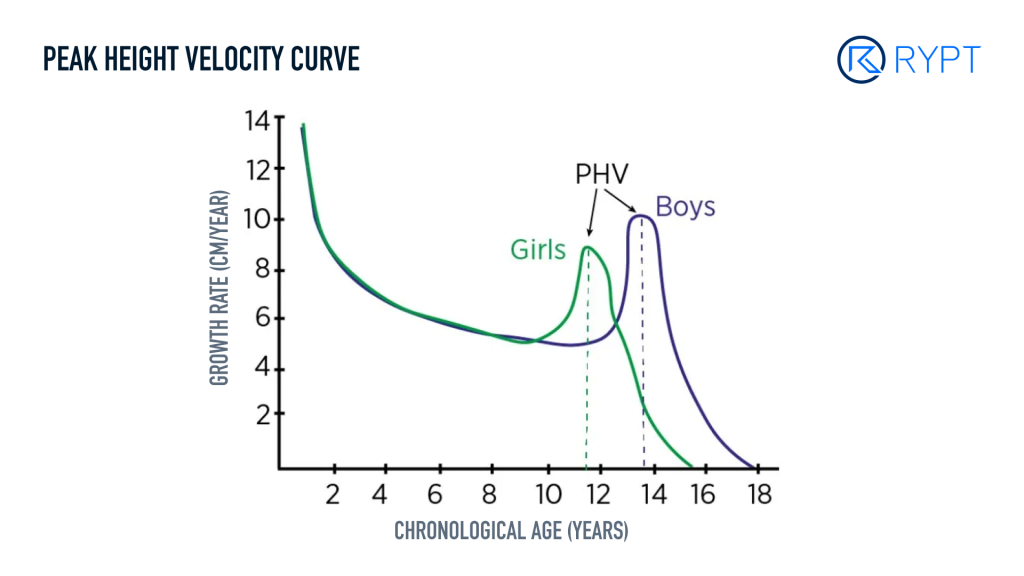
It is a crucial indicator used by strength and conditioning coaches and sports scientists to assess maturity. Typically, Females experience Peak Height Velocity earlier than males. It can start anywhere from the age of 9 in females, with a mean age of 11.5 years, and from the age of 11 in males, with a mean age of 13.5 (Abbassi, 2018). However, this can vary based on genetic and environmental factors.
Why is Peak Height Velocity important?
Using Peak Height Velocity to Tailor Training Programs
Studies suggest that there are certain times, pre-, mid-, and post-PHV, `when youth athletes are more sensitive to particular types of training and that adaptations can be maximized if the athlete’s program is tailored to their biological age or maturity.
For example, it’s suggested that pre-adolescents benefit more from training that includes high levels of neural activation, such as sprint training and plyometrics. Whereas, adolescents respond better to training that targets both neural and structural development, such as combining strength training and plyometrics (Rumpf et al., 2012).
Furthermore, adolescents are understood to respond more favourably to hypertrophy training than pre-adolescents due to the higher concentrations of testosterone and growth hormone (Malina et al., 2004) (Viru et al., 1999).
Peak Height Velocity, Growth Rate, and Injury Risk
Peak Height Velocity is not only a marker of growth but also a critical period for managing injury risk. During their growth spurt, adolescents experience changes in bone density, muscle strength, and coordination. As a result, athletes who are mid-PHV have been associated with having a significantly higher risk of injury, compared with pre and post-PHV athletes (Monasterio et al., 2023).
Growth rates are also an important factor. Growth rates greater than 7.2 cm/year in males and 6.7 cm/year in females, or greater than 6 kg/year in males, or 5.5 kg/year in females are associated with increased injury risk (Monasterio et al., 2024).
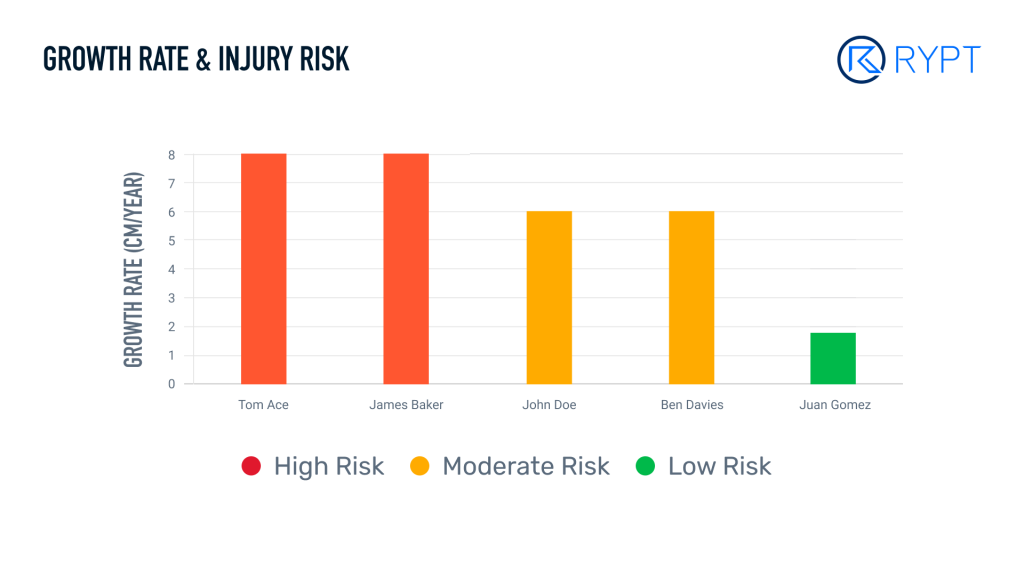
Monitoring growth rates and timing of Peak Height Velocity allows coaches to adjust training loads and implement injury prevention strategies. A study found that understanding growth spurts can help in tailoring training programs to reduce the risk of overuse injuries in young athletes (Philippaerts et al., 2006).
Peak Height Velocity and Maturity Timing
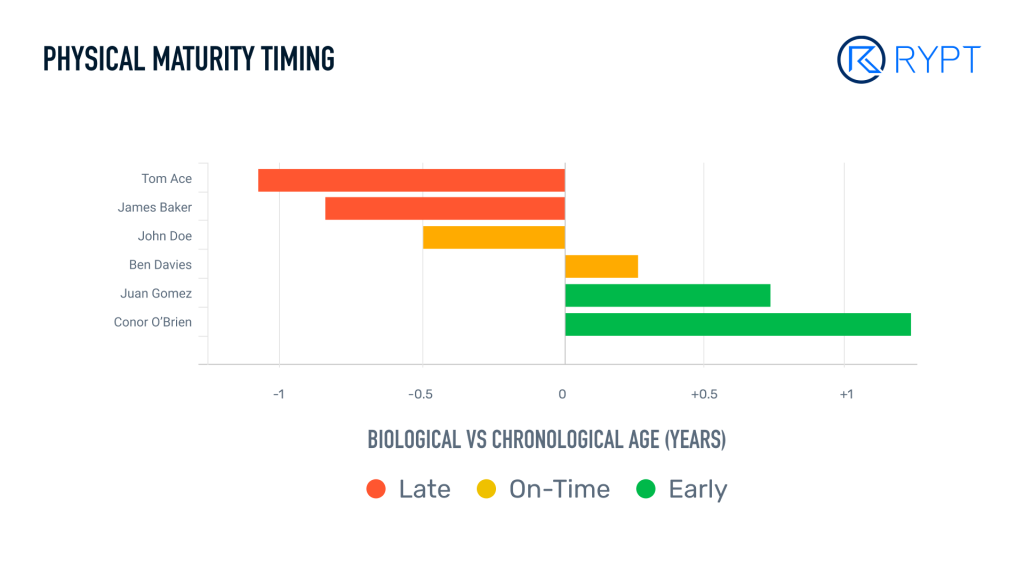
Peak Height Velocity can also be used to calculate an athlete’s biological age and determine whether they are a late, on-time, or early maturer. This can help with talent identification to ensure that biases towards early developers who are more physically imposing than their late developer peers are identified. Ensuring late developers, who are potentially better psychologically, technically, or tactically, are not overlooked.
It can also be utilised to maximise the development of youth athletes, by using bio-banding to group them by their biological as opposed to their chronological age. This levels the playing field for all athletes, helping late developers improve by getting more involvements in games, and helping early developers improve their skills rather than relying solely on their physical attributes.
Conclusion
Understanding and utilizing Peak Height Velocity is essential for optimizing the development and safety of youth athletes. By recognizing the timing of Peak Height Velocity, coaches can tailor training programs to align with an athlete’s biological maturity, enhancing performance and reducing injury risk. This approach not only aids in effective talent identification by distinguishing between early and late maturers but also promotes equitable development through strategies like bio-banding.
As such, Peak Height Velocity serves as a valuable tool in fostering a balanced and supportive environment for young athletes, ensuring their growth is both healthy and conducive to long-term success in sports.
References
- Abbassi, V. “Growth and normal puberty.” Pediatrics vol. 102,2 Pt 3 (1998): 507-11.
- Malina RM et al. “Growth, Maturation, and Physical Activity.” Champaign, IL: Human Kinetics (2004). pp. 41–77.
- Monasterio, Xabier et al. “The combined effects of growth and maturity status on injury risk in an elite football academy.” Biology of Sport, vol. 41, no. 1 (2024), pp. 235-244. doi:10.5114/biolsport.2024.129472.
- Monasterio, Xabier, et al. “Peak Height Velocity Affects Injury Burden in Circa-PHV Soccer Players.” International Journal of Sports Medicine, vol. 44, no. 4 (2023), pp. 292-297. Thieme, doi:10.1055/a-1983-6762.
- Philippaerts RM, Vaeyens R, Janssens M, Van Renterghem B, Matthys D, Craen R, Bourgois J, Vrijens J, Beunen G, Malina RM. (2006). The relationship between peak height velocity and physical performance in youth soccer players. Journal of Sports Sciences, 24(3):221-230. doi: 10.1080/02640410500189371.
- Rumpf MC et al. “Effect of different training methods on running sprint times in male youth.” Pediatr Exerc Sci. (2012).
- Viru, A. at al. Critical periods in the development of performance capacity during childhood and adolescence.” European Journal of Physical Education (1999) 4: pp.75–119.
Did you enjoy this article?

If so, then please share it
About RYPT
RYPT is an athletic development software platform designed to help multi-disciplinary coaching teams deliver athletic development programs and monitor performance efficiently, at scale.
RYPT helps coaching teams manage every aspect of their coaching relationship from delivering individualized training plans, to monitoring readiness and workload, to tracking growth and maturation, menstrual cycle, and injuries. Centralizing data and streamlining communication to help coaches reduce injury risk and optimize performance.
Over 4,000 coaches worldwide, working from grassroots to Olympic level, trust RYPT to deliver their athletic development programs and monitor their athletes. RYPT supports individual coaches, sports teams, private gyms and academies, schools and universities, and large sporting organisations.

What are you waiting for?
Talk to our team and see how RYPT can help you






Want to leave a comment about this article?
Your email address will not be published. Required fields are marked *